
Best betting sites with acca bets: how accumulators work and which UK bookmakers offer them
 Available in US
Last updated: 30. October 2026 · Licence and offer data checked against the Gambling Commission’s public register.
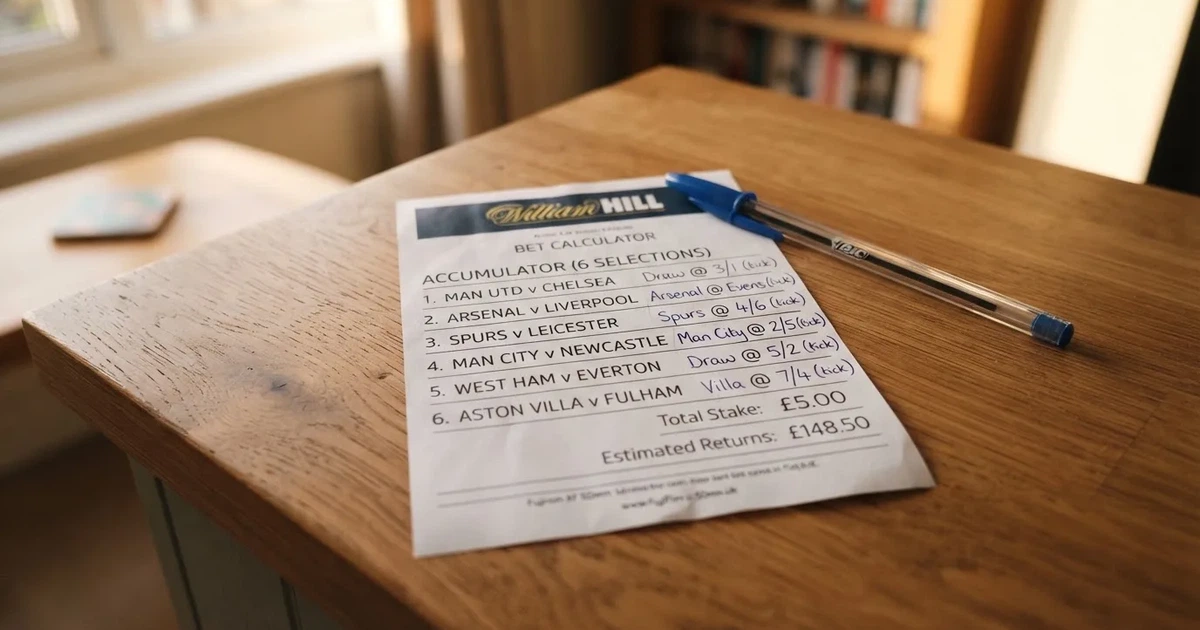
An accumulator is the kind of bet that makes a £10 stake feel like it could change a Sunday. It is also the kind of bet that turns four comfortable singles into one coin-toss — and the bookmaker’s margin grows with every leg you add. This guide is about how accas actually work, what they cost the punter, and which UK-licensed bookmakers offer them in a way that suits different kinds of bettor.
The choice sits in three places. The structure of the bet — a single accumulator, a Trixie, a Heinz — decides how forgiving the bet is when one leg fails. The bookmaker decides what acca features come baked in: a price boost, acca insurance, a bet builder, an each-way option. The punter’s own bankroll decides what a sensible stake looks like when one losing leg wipes the whole slip. The pages that follow work through each of those choices in turn.
Safer gambling: what every UK acca punter needs in place first
An accumulator is not a casual bet. It survives only if every leg wins, and the urge to recover a lost acca by adding one more leg the next time is the precise habit the British regulator has built its player-protection regime around. Before any of the operators below are compared, the safety net has to be named in full.

The national scheme is GAMSTOP. Any online bookmaker licensed by the Gambling Commission in Great Britain has to take part, and the registration is free, online and reversible only after the minimum exclusion period has run. The options are six months, one year, five years, or five years with auto-renewal, and once the minimum period ends the exclusion stays in place for a further seven years unless the customer asks GAMSTOP to remove it. Betting shops are covered by a separate, in-shop self-exclusion scheme rather than GAMSTOP itself, so anyone who bets in person and online needs to use both. The point of registering is not a wagering cap; it is a wall between the bettor and every licensed site for the chosen period.
The second layer is the licensed operator’s own controls, which are now tightly specified. Identity is checked before the first deposit — name, address and date of birth — and the check covers free bets and bonuses too, so anonymous play is gone from the British licensed market. A financial vulnerability check fires once a customer’s net deposits cross £150 in any rolling 30-day window; it is a public-record check (bankruptcy, county court judgments) rather than a credit reference or income check, and it has been live since 28 February 2025. Wagering requirements on bonuses are capped at 10x under rules in force since 19 January 2026, so a £10 bonus cannot require more than £100 of qualifying bets; mixed-product promotions (an offer that asks the punter to bet on football to get free spins, for instance) are banned. A separate, staged plan around affordability checks — financial risk assessments in the Commission’s language — was published on 7 July 2026; it is announced, staged and has no start date, and the cap on it remains undetermined.
Where the bettor gets help when those layers are not enough: GamCare runs the National Gambling Helpline, GambleAware funds treatment and education, the NHS runs gambling clinics in several regions, and Gamblers Anonymous runs peer-support meetings. The 10x cap and the £150 check apply only to operators holding a Gambling Commission licence, and that distinction is the hinge of the rest of this page: a punter on an unlicensed offshore site gets none of the protections named above.
Acca bonuses and free bets: what the marketing words actually mean
The “acca” cluster is where the offers are loudest, so it is the right place to start when reading the small print. A free bet looks like a gift and reads like one in the marketing, but the way the bookmaker structures it decides what it is really worth. Three patterns cover most of what a UK punter will meet, and each has its own arithmetic.

The first is the matched free bet. Dabble’s “Bet £10, Get £10 in Free Bets” is a current example, with a seven-day free-bet expiry and minimum odds on the qualifying bet, and BetGoodwin’s “Bet £10 & Get £15 in Free Bets” breaks the £15 into a £5 sports single, a £5 acca and a £5 Sub-Cover bet, so the acca portion of the offer is small in money terms but it does let the punter try the acca product with house money. The catch is the one shared by every matched free bet: when a free bet wins, the stake is not paid back, only the profit, so a £10 free bet at 3/1 returns £30 in profit, not £40. The free bet’s value to the punter is therefore stake × (odds − 1) ÷ odds × payout share of the market it is placed on — never the headline figure. A free bet that is only redeemable at minimum odds of 1/2 (1.50) on a market with a 6% margin is worth roughly 44p on the pound, before any deadline, and the deadline is the second thing to check because the seven-day window is common and short.
The second is the price boost and the “enhanced odds” offer. Kwiff’s Supercharge feature can lift a price instantly — the example the operator gives is a 2/1 shot becoming 20/1, and it can apply to singles or multis. bet365 layers the same idea in two ways: Super Boosts on selected markets and Winnings Boosts on Bet Builders and selected singles, plus a daily Bet Boost. The arithmetic is friendlier here than for a free bet because the stake is paid back as normal — the boost is on the odds, not on a free-bet token — but the boosted price is almost always capped, and the cap is per customer and per match. Read the cap before judging the offer: a “boost to 50/1” with a £5 stake ceiling is a £250 ceiling on profit, not the five-figure payout the headline implies.
The third is acca insurance. The mechanic is simple: one leg lets the bet down and the bookmaker refunds the stake as a free bet, usually up to a cap. The arithmetic is less friendly. The free-bet refund carries its own minimum odds, its own expiry and its own list of eligible markets, and a punter who places a six-leg acca to “trigger the insurance” has paid for six legs of margin to recover a stake the insurance then pays back as another bet, not as cash. The insurance is a partial hedge against the loss of a single leg, and it is worth treating as one rather than as a profit centre.
The offer rules that bind all three patterns come from the same place. Wagering requirements on bonuses are capped at 10x; a £10 free bet at 50x wagering is unlawful under the current rules. The 19 January 2026 changes also closed the mixed-product route: an offer that asks the punter to bet on football to get casino free spins is no longer permitted. BetUK’s free-bet terms already exclude virtual sports, esports and non-UK/IE horse racing, with minimum odds applying, and that is a fair picture of the kind of market restriction that turns up across the licensed set.
The honest reading of the acca bonus shelf is this: a free bet is a marketing cost dressed as a gift, a price boost is the closest the punter gets to a fair deal, and acca insurance is a refund in another bet rather than a refund in money. The bookmaker’s margin sits inside every leg, so the only “free” thing about the offer is the first bet the punter places with their own money to qualify for it.
Predictions, tipsters and the price of a “sure thing”
The search for “best acca bets today” and the like runs into a hard fact. Nobody can know the outcome of a sporting event in advance, and an accumulator compounds that ignorance with one extra layer of uncertainty per leg. A four-fold at 2/1, 5/4, 6/4 and 11/8 sounds like a steady 11/1; in fact, the bet loses if any one of four independent events fails, and the bookmaker’s margin is built into each of the four prices. The number printed at the bottom of the slip is the reward for an event whose probability the punter can estimate but never pin down.
The “predictions” shelves of acca betting are not what they look like. A tipster selling a “today’s acca” is selling a selection of bets at a price the punter could read off a betting slip themselves. A model producing a probability per leg is closer to useful, but only if the model is calibrated — and the calibration of an acca model is harder to check than the calibration of a single-event model, because the acca wins rarely enough that the sample size is small. The 2/1 shot the model rates as a 40% chance is still a 60% chance of losing, and the four-fold combining four of them is a 60% chance of losing on each leg, with the overall probability multiplying to roughly 13%.
The strategy section of the acca shelf is more interesting. A punter who treats the acca as a long-shot wager rather than a primary betting format places small stakes, accepts the high variance, and never increases the stake to “chase” a previous loss. A punter who treats the acca as a way of extracting a price boost from a bookmaker (Supercharge, Super Boost, Winnings Boost) is using the acca as a wrapper for a value bet, and the value sits in the boost, not in the legs. A punter who uses acca insurance to hedge a single weak leg on an otherwise solid multi is using the insurance for what it is rather than for what the marketing calls it. None of these strategies improves the probability of any leg winning. They change what the bet costs and what it pays when it lands.
Two practical rules follow. The first is to keep the stake a small fixed percentage of a bankroll the punter can afford to lose in full, because the acca will lose more often than it wins and the bankroll has to survive the losing run. The second is to read the price the bookmaker is offering rather than the price the tipster is quoting, and to check it against at least one other bookmaker’s price on the same selection. A 5/4 shot at one firm and an 11/10 shot at another is a one-price difference, and over a season the difference is the difference between a winning and a losing acca strategy at the same strike rate.
What an acca is, how it settles, and what the price really means
The acca is a single bet that links two or more selections, and it pays out only if every selection wins. A leg that loses loses the whole bet. A leg that ties — a push in the American term, a dead heat in the British one — is removed and the acca is settled on the remaining selections, with the odds reduced accordingly. A non-runner in a horse race is usually removed under Rule 4 deductions and a similar removal, depending on the operator’s rules. The point is that the acca is a single bet, not a bundle of bets in one wrapper, and a single failure voids the stake.
The payout is the product of the odds of each leg. A four-fold at 5/2, 6/4, evens and 11/8 (decimal 3.50, 2.50, 2.00, 2.375) pays 3.50 × 2.50 × 2.00 × 2.375 = 41.5625, so a £10 stake returns £10 × 41.5625 = £415.63 if every leg wins, and returns nothing if any leg loses. The arithmetic is why decimal odds suit accumulators: the multiplication is direct, and the reader can sanity-check the bookmaker’s combined price with a calculator. Fractional odds on a long acca become hard to verify because the fractions compound.
The full-cover bets are accas with insurance built in. A Trixie covers three selections in four bets — three doubles and a treble — so a losing leg takes out only the doubles it sits in, not the treble. A Yankee covers four selections in eleven bets; a Lucky 15 covers four selections in fifteen bets and adds four singles; a Canadian (or Super Yankee) covers five selections in twenty-six; a Heinz covers six in fifty-seven; a Super Heinz covers seven in a hundred and twenty; a Goliath covers eight in two hundred and forty-seven. The full-cover bets are more forgiving than a straight acca because they do not require every leg to win, and they are more expensive because the unit stake is multiplied by the number of bets. A £2 Trixie costs £8 in total stake, a £2 Lucky 15 costs £30, and a £2 Goliath costs £494 — and the £494 is the cost of having a bet that can pay out even when several legs lose.
The arithmetic of an acca’s cost is the same arithmetic that determines what the bookmaker keeps. Every decimal price in a market carries an overround — the bookmaker’s margin — and a 1X2 football market with a 5% margin returns 95p on the pound in expectation, regardless of which outcome the punter backs. A four-fold with a 5% margin on each leg has a compounded margin of roughly 1 − 0.95^4 = 18.5%, so the punter is paying roughly 18.5% of every pound staked for the privilege of combining the four bets. The combined price on the slip is the price the punter is being asked to take; the implied probability is the reciprocal of that price; and the gap between the two is the bookmaker’s cut, multiplied by the number of legs.
The slot for a worked example sits here. The example is illustrative, not a quoted price, and the inputs are a £10 stake on a treble of 1/2 (1.50), evens (2.00) and 6/4 (2.50). The combined decimal price is 1.50 × 2.00 × 2.50 = 7.50, so the return on a winning £10 stake is £10 × 7.50 = £75 (profit £65), and the implied probability of all three legs winning is 1 ÷ 7.50 = 13.3%. The same three selections as a Trixie — four bets, three doubles and a treble, at £2 per line for an £8 total stake — return the £8 only if all three win, and the maximum payout (the treble alone winning) is £2 × 7.50 = £15, so the Trixie trades a smaller upside for a more forgiving structure. The condition on this kind of calculation is that the prices are the prices the bookmaker is actually offering; a one-price difference on a single leg changes the combined price, and therefore the margin, materially.
The 1/2, evens and 6/4 example is also a fair picture of how a bookmaker’s acca margin shows up. If the same three selections were each at 0.95 of their true price (a 5% overround on each), the combined price would be 1.50 × 0.95 × 2.00 × 0.95 × 2.50 × 0.95 ≈ 6.445, not 7.50, and the implied probability of winning would be 15.5% rather than 13.3%. The acca punter pays the overround three times, and the only way to see it is to convert the decimal price on the slip back into a probability and compare it to the probability the punter would assign to the bet.
The ten UK-licensed bookmakers in this comparison
The choice the page is built around is which bookmaker to place the acca with, and the comparison covers ten operators on the Gambling Commission’s public register, each licensed for remote general betting on real events. The brands are not ranked by quality or by offer value — each one is judged on what it actually offers the acca punter rather than on its welcome bonus.
| Operator | Licence (Remote) | Acca Features and Terms |
|---|---|---|
| bet365 | Remote licence 055148-R-331498-002; Hillside (UK Sports) ENC | Bet Builder+ lets the punter combine markets from one event into a single bet pre-match and in-play; Super Boosts, Winnings Boosts on Bet Builders and selected singles, and a daily Bet Boost. |
| Geoff Banks | Remote licence 054095-R-330366-010; GB Sports Advisors Limited | Live in-play prices and ante-post markets; the brand runs as an independent sportsbook rather than as a generalist. |
| Kwiff | Remote licence 044448-R-323408-017; Eaton Gate Gaming Limited | Supercharge can boost the odds on a bet instantly (2/1 to 20/1 in the operator’s own example), on singles and multis on any sport. |
| Fitzwilliam Sports | Remote licence 048760-R-335434-009; SBKI Limited | Prices are based on Oddschecker’s average price for each selection; iOS and Android apps. |
| Dabble | Remote licence 065677-R-340363-005; Dabble Sports UK Ltd | Welcome offer “Bet £10, Get £10 in Free Bets” on first deposit, with minimum odds, a seven-day free-bet expiry and the stake not returned. |
| Swifty Sports | Remote licence 058957-R-334734-006; Swifty Global (UK) Ltd | Best Odds Guaranteed, Cash Out on horse racing and football, daily price boosts, live streaming and in-play; Bet Builder listed as coming soon. |
| Octobet | Remote licence 062545-R-337248-006; Octopus Game Limited | Best Odds Guaranteed on UK and Irish horse racing, up to £150 per customer per race. |
| BetGoodwin | Remote licence 002927-R-327985-008; Goodwin Racing Limited | Welcome offer “Bet £10 & Get £15 in Free Bets” split as a £5 sports bet, a £5 acca and a £5 Sub-Cover bet. |
| Betfred | Remote licence 039544-R-319290-010; Petfre (Gibraltar) Limited | Bet Builder, Sub Switch, Racing Post data, Extra Places, live casino and bingo in the same app. |
| BetUK | Remote licence 039198-R-319450-029; LeoVegas Gaming PLC | Free bets exclude virtual sports, esports and non-UK/IE horse racing, with minimum odds applying. |
bet365
bet365 is the brand most acca punters in Great Britain will already have an account with, and the breadth of the acca product is the reason. Bet Builder+ lets the punter combine markets from one event into a single bet pre-match and in-play, which is the cleanest way to build a same-game multi; the Winnings Boosts apply to Bet Builders as well as to selected singles, and Super Boosts run daily. The acca punter gets four overlapping acca features (Bet Builder, Super Boost, Winnings Boost, daily Bet Boost) in one app, and the punter who wants everything in one place is the punter bet365 is built for. The catch is the size: the welcome offer is modest against smaller brands, the in-play markets are deep enough that the punter can drown in choice, and the verification before the first deposit is thorough. A serious acca punter with a settled bankroll gets the most out of bet365; a casual punter who only places the occasional Saturday treble may be paying for product they will not use.
Geoff Banks
Geoff Banks is a small, independent sportsbook rather than a generalist, and the app reflects that. The product is live in-play prices and ante-post markets on future events, run by GB Sports Advisors Ltd. An acca punter looking for a Bet Builder or a daily price boost is in the wrong place; an acca punter looking for sharp ante-post prices on horse racing or a long-range football future will find what they want. The acca itself is a standard same-firm multi, and the brand’s edge is the price rather than the wrapper. A punter who values an independent bookmaker with a personal feel over a feature-heavy app gets on well here; a punter who wants Bet Builder, cash out and a packed live lobby is mismatched.
Kwiff
Kwiff’s pitch is the Supercharge feature, and the example the operator gives — 2/1 becoming 20/1, on a single or a multi — is the kind of price change a punter can build an acca strategy around. Supercharge fires at random, so the punter is not choosing when to take the boost; the punter places a bet at the offered price and Kwiff decides afterwards whether the boost lands. The acca punter who likes randomness in the price and a generous ceiling on the boosted payout gets something Kwiff’s competitors do not offer; the punter who wants a stable, predictable price does not. The licence is held by Eaton Gate Gaming Limited and the app is rated 17+ on the App Store, so the standard GB controls apply.
Fitzwilliam Sports
Fitzwilliam Sports is a price-led bookmaker, and the way it sets prices is the most legible part of the offer: each selection is priced off Oddschecker’s average, which means the punter is getting a market-average price rather than a price the bookmaker has sharpened to its own margin. The acca punter who shops around for the best price on each leg is the punter who will appreciate this most, because the average-price discipline tends to push margins down. The product is otherwise standard — sportsbook with iOS and Android apps, no standalone Bet Builder marketing — and the licence is held by SBKI Limited. A price-disciplined acca punter fits well; a punter chasing boosts and acca insurance does not.
Dabble
Dabble is built around social betting — the app places chat and copy-betting features alongside the standard sportsbook — and the welcome offer is the headline: “Bet £10, Get £10 in Free Bets” on first deposit, with minimum odds on the qualifying bet, a seven-day free-bet expiry and the stake not returned. The £10 free bet is on the low side of the matched-free-bet cluster, and the seven-day expiry is short. The acca punter who is on the app for the social features as well as the betting will use the free bet inside the window; the punter who forgets about the offer for two weeks will lose it. Dabble Sports UK Ltd holds the licence and the bookmaker takes part in GAMSTOP.
Swifty Sports
Swifty Sports is the acca punter’s mid-market bookmaker: Best Odds Guaranteed, Cash Out on horse racing and football, daily price boosts, live streaming and in-play, with Bet Builder listed as coming soon on the app. The acca punter who wants a clean price on a Saturday morning, who wants to cash out a winning acca in-play, and who will use a Best Odds Guaranteed concession on the horse racing rather than on the football, has the right bookmaker. The punter who is waiting for the Bet Builder to land is mismatched, because “coming soon” is not a feature the punter can bet on. Swifty Global (UK) Ltd holds the licence.
Octobet
Octobet’s acca offer runs through its horse racing product rather than through its football product, and the headline is Best Odds Guaranteed on UK and Irish horse racing up to £150 per customer per race. The cap is the figure the punter has to read: £150 per customer per race is a ceiling on the win, not a floor, and a punter whose stake is below the ceiling sees the full benefit. The acca punter whose book is racing-led and who places the racing leg of an acca with Octobet gets value; the punter whose book is football-led sees a thin acca offer and a BOG concession on the wrong sport. Octopus Game Limited holds the licence.
BetGoodwin
BetGoodwin is a small UK bookmaker with a substantial welcome offer for the size of the brand, and the structure of the offer is the right place to start. “Bet £10 & Get £15 in Free Bets” is split as a £5 sports single, a £5 acca and a £5 Sub-Cover bet, so the acca punter gets £5 to place on a multi with house money, alongside two other tokens the punter can use elsewhere. The acca punter who wants to try the acca product without risking their own stake on the first acca has a fair offer; the punter looking for a £30 free bet in one piece is in the wrong place. Goodwin Racing Limited holds the licence and the brand has a racing heritage that shows in the product.
Betfred
Betfred is a familiar name in British betting shops and the online product is the same one the high-street punter already uses, with a Bet Builder, Sub Switch (which lets the punter substitute a non-runner on a horse racing accumulator), Racing Post data, Extra Places, live casino and bingo in the same app. The acca punter who wants a one-stop app with a horse racing heritage and an in-app data feed gets what they came for; the punter looking for a small, price-led independent is in the wrong place. Petfre (Gibraltar) Limited holds the licence, so the GB controls and the bonus cap apply.
BetUK
BetUK is part of the LeoVegas Gaming PLC group, and the acca offer is the standard sportsbook product with a clear restriction set: free bets exclude virtual sports, esports and non-UK/IE horse racing, with minimum odds applying. The exclusion list is the figure the punter has to read, because a punter who places a qualifying bet on virtuals and tries to trigger the free bet has done the work for nothing. The acca punter whose book is UK and Irish football, UK and Irish horse racing, and the mainstream sports, has the right bookmaker; the punter who wants esports or virtuals as part of the acca is mismatched.
The accumulator landscape in the licensed British market
The acca is the single most common multi-leg bet on a British licensed sportsbook, and the licensed market is large enough that the punter is choosing within a deep field rather than between two or three brands. The Gambling Commission’s public register lists remote general betting standard (real events) licensees as a category in their own right, and the ten brands in the comparison above are a slice of that category, not the whole of it. Several brands run under one licensee — Ladbrokes and Coral under Entain, Paddy Power and Betfair under Flutter — so the number of operators on the register is smaller than the number of brands a punter can bet with.
The bookmaker’s margin is the one feature every acca punter meets on every bet, and the spread of margins across the licensed set is wider than the marketing suggests. Best Odds Guaranteed on horse racing, a price boost on a selected market, and a Winnings Boost on a Bet Builder are all real concessions, and the punter who reads the small print can find a bookmaker whose margin on the markets they bet on is below the market average. The bookmaker who advertises the highest acca boost is rarely the bookmaker with the lowest base margin, and the punter who reads the slip rather than the homepage does better over a season.
The acca product is not the same product at every bookmaker. Bet Builder is standard at the larger brands and absent at smaller ones. Cash out on a winning acca is a standard feature at the larger brands and a per-event opt-in at others. Live streaming is a standard feature at the larger brands and absent at smaller ones. Acca insurance (a refund as a free bet if one leg lets the bet down) is offered at some but not all of the brands in the comparison, and the cap on the refund and the list of eligible markets vary. The punter’s choice is therefore not “which bookmaker offers accas” — they all do — but which bookmaker offers the acca product the punter will actually use.
The legal frame: licences, offers and what the rules mean for an acca
The Gambling Commission is the regulator for the whole commercial betting market in Great Britain, set up under the Gambling Act 2005 and operating through operating licences and the Licence Conditions and Codes of Practice (LCCP). Since the Gambling (Licensing and Advertising) Act 2014 an operator whose remote facilities are used in Great Britain needs a Commission licence wherever it is based, and a Curaçao, Maltese or Gibraltar licence is not a substitute. There is no state monopoly and no statutory cap on the number of licences, so the licensed market is a competitive one.
The way a punter checks a licence is the public register. The register is searchable by business name, trading name, domain or account number, and the test of whether a brand is licensed is whether the brand appears against a Commission account number. The domain is not the test: licensed operators use .com as well as .co.uk, and the absence of .co.uk proves nothing. A brand that does not appear on the register is unlicensed, and an unlicensed brand is not subject to the LCCP, the bonus cap, the GAMSTOP condition or the financial vulnerability check. The punter is betting with an operator outside the British consumer-protection regime, and the consequences of a dispute are not British ones.
The licence categories that cover an acca bet are remote general betting standard (real events) for the main set, and remote betting intermediary for betting exchanges. The remote general betting standard (virtual events) category is a separate licence for virtual markets and does not cover real sporting events. Pool betting on horse or dog racing is a separate licence again. An acca punter who places a bet on a Premier League football match at a licensed bookmaker is betting under a remote general betting standard (real events) licence, and the bet is settled under the LCCP and the operator’s own terms.
The offer rules sit alongside the licence. Wagering requirements on bonuses are capped at 10x as of 19 January 2026, so a £10 bonus cannot require more than £100 of qualifying bets; mixed-product promotions are banned under the same rules. The £150 financial vulnerability check fires when net deposits cross that threshold in a rolling 30-day window. The deposit-limit rules (Remote Technical Standards 12) have applied in part since 31 October 2025 and a second phase was postponed to 30 September 2026; whether the second phase is live is not settled. None of the offer rules apply to an unlicensed brand, because the rules apply to the operator, not to the bet.
The advertising frame sits alongside the offer rules. The CAP Code (non-broadcast) and BCAP Code (broadcast) are enforced by the Advertising Standards Authority, and the LCCP social responsibility code applies directly to operators. Section 16 of the CAP Code requires marketing to be socially responsible, not of strong appeal to under-18s, and not to feature anyone who is or seems to be under 25 in a significant role (with an exception for marketing placed at the point of sale). The “whistle-to-whistle” ban on TV betting advertising around live sport before the 9pm watershed has been in force since 1 August 2019; horse and greyhound racing are excluded. The Premier League’s voluntary withdrawal of front-of-shirt gambling sponsorship from 2026/27 onwards is a club-level decision rather than a law.
The tax frame completes the picture. The player pays no tax on betting winnings in Great Britain — this is general information, not tax advice, and a professional gambler should ask HMRC or an adviser. General Betting Duty is the operator’s tax on gross profits and is currently 15%; from 1 April 2027 a new remote betting rate of 25% applies within it, while remote bets on UK horse racing, self-service betting terminal bets, pool betting and in-person betting stay at 15%. Until 1 April 2027 the remote rate is unchanged, and whether operators pass the rate on through odds is not established. The acca punter does not pay duty, and the duty change is a margin question for the bookmaker rather than for the customer.
The offshore frame is the other side of the choice. A GB licence is compulsory at the point of consumption, and providing gambling facilities in Great Britain without the licence the Act requires is an offence under section 33 of the Gambling Act 2005 (on summary conviction up to 51 weeks’ imprisonment, a fine up to level 5, or both; six months in Scotland). The offence is aimed at the operator, not the customer. The punter on an unlicensed site loses the British protections: no GAMSTOP coverage, no Commission complaints route, no approved dispute-resolution body, no British consumer redress if funds are withheld, no 10x bonus cap, no £150 vulnerability check. The Commission’s enforcement is disruption (cease-and-desist notices, search-engine referrals, work with registrars, hosts and payment providers) rather than blocking, and court-order DNS blocking powers are recent and not yet in operation at scale. The honest framing is that licensed means checks, limits, GAMSTOP and the bonus cap, but also verification before the first bet; unlicensed means none of those protections and the risk of losing the stake to an operator with no British consumer redress. Neither is “the safe choice” by default — the punter’s choice is which trade-off they prefer.
How to choose an acca bookmaker
The choice runs in three steps. The first is to pick a bookmaker that holds a remote general betting standard (real events) licence from the Gambling Commission, and to check the brand against the Commission’s public register rather than trusting the homepage. The ten brands in the comparison above all appear on the register, and the licence number on the homepage should match the register entry; if it does not, the punter bets elsewhere.
The second is to pick the acca product the punter will actually use. The punter who places Saturday morning horse racing accas with a Best Odds Guaranteed concession needs a bookmaker whose BOG covers UK and Irish racing, and the punter whose book is football-led needs a bookmaker with a Bet Builder and a Super Boost or Winnings Boost. The bookmaker with the highest welcome bonus is rarely the bookmaker whose everyday acca product is the best fit, because the everyday product is what the punter pays margin on and the welcome bonus is a one-off.
The third is to manage the bankroll. The acca is a high-variance bet, and the stake has to be small enough that a losing run of six or eight accas does not break the bank. A fixed unit stake — say 1% of the bankroll — keeps the punter in the game, and the punter who increases the stake to recover a loss is the punter the GAMSTOP scheme was built to interrupt. The £150 financial vulnerability check and the GAMSTOP self-exclusion are the two controls the punter can use before a habit becomes a problem, and the safer-gambling section of this page sets them out in full.
Frequently asked questions
What are acca bets?
An acca is a single bet that links two or more selections and pays out only if every selection wins. A losing leg loses the whole bet, a tied leg is removed and the acca settles on the remaining selections, and the payout odds are the product of the odds of each leg. A Trixie, Yankee, Lucky 15, Heinz or Goliath is a full-cover variant that combines the selections into several bets and pays out on combinations as well as on the full multi.
How do accumulator acca bets work?
A £10 stake on a four-fold at 5/2, 6/4, evens and 11/8 (decimal 3.50, 2.50, 2.00, 2.375) pays 3.50 × 2.50 × 2.00 × 2.375 = 41.5625 if every leg wins, returning £415.63. A losing leg voids the stake, a tied leg reduces the price, and a non-runner in a horse race is usually removed under Rule 4 deductions. The bookmaker’s margin is built into each leg, so the acca punter pays the overround once per leg, and the combined implied probability of winning is the reciprocal of the combined price.
How can it be checked that a bookmaker holds a Gambling Commission licence?
The Gambling Commission publishes a public register of every licensed operator, searchable by business name, trading name, domain or account number. The test of a brand’s licence is whether the brand appears against a Commission account number on the register, and the licence number on the brand’s own homepage should match. A domain is not the test, because licensed operators use .com as well as .co.uk, and a brand that does not appear on the register is unlicensed and outside the British consumer-protection regime.
How is the return on a bet worked out from the stake and the odds?
The return on a winning bet is the stake multiplied by the decimal odds, and the profit is the return minus the stake. A £10 stake at decimal odds of 4.50 returns £45 (profit £35); a £10 stake at fractional odds of 7/2 (decimal 4.50) returns the same. For an accumulator, the decimal odds of each leg are multiplied together to give the combined price, and the return is the stake multiplied by the combined price.
What is the bookmaker’s margin and how can it be seen in the odds?
The bookmaker’s margin is the cut the bookmaker keeps of every pound bet on a market, and it sits inside the prices. In a 1X2 football market with home 2.10, draw 3.40, away 3.60, the implied probabilities add up to 1 ÷ 2.10 + 1 ÷ 3.40 + 1 ÷ 3.60 = 0.476 + 0.294 + 0.278 = 1.048, and the margin is the 4.8% above 100%. The punter who reads the prices on the slip and converts each to an implied probability can see the margin directly, and the punter who shops around for the lowest margin gets the best price on the same selection.
Bet types & in-play – Legalbettinguk.com
Content created by the «Legalbettinguk.com» team
