
Badminton betting odds in Great Britain for 2026: who offers what
 Available in US
Data current as of 30. October 2026. Against the Gambling Commission’s public register.
Badminton is not a headline sport in British bookmaking. Football, horse racing and tennis pull the front of every shop window; badminton sits a few rows back, somewhere behind darts and table tennis. That is the practical shape of the question a reader is asking. The BWF World Tour, the All England Open, the Thomas & Uber Cups and the Thomas/Uber finals do get priced — by every generalist sportsbook and by a couple of specialists — but the depth of the menu is narrower than in tennis, and the in-play product is thinner still. Anyone who arrives at the market thinking they will get the same coverage they would for a Premier League match is finding disappointment on day one.

This page is a guide to that market as it actually exists in Great Britain. It walks through how a game of badminton is played and how a bookmaker structures its odds, which tournaments and disciplines appear on a typical betting slip, what the bookmaker’s margin does to the numbers a bettor sees, and which UK-licensed bookmakers actually take bets on the sport. It is not a tip sheet and not a system. Nobody knows who will win the next rally, and nobody on the page ahead is pretending otherwise. What follows is the shape of the offer, the cost of the marketing around it, and the questions a bettor should answer before placing a stake.
Fundamentals: how a badminton match is actually played
A badminton match is played to 21 points per game with rally-point scoring — meaning every rally produces a point, no matter who served. A match is the best of three games: the first player or pair to win two games takes the match. At 20–20 play continues until one side leads by two clear points, and at 29–29 the side that wins the next point takes the game. The deuce rule at 20-all and the sudden-point rule at 29-all are the two structural breaks that decide more sets than raw skill does. A bettor who treats a match like a tennis match — where sets are also played to six with a tiebreak — is betting on a sport that looks similar and scores quite differently. There is no service game. There is no second serve. The point is won or lost on a single shuttle, and the next rally starts.

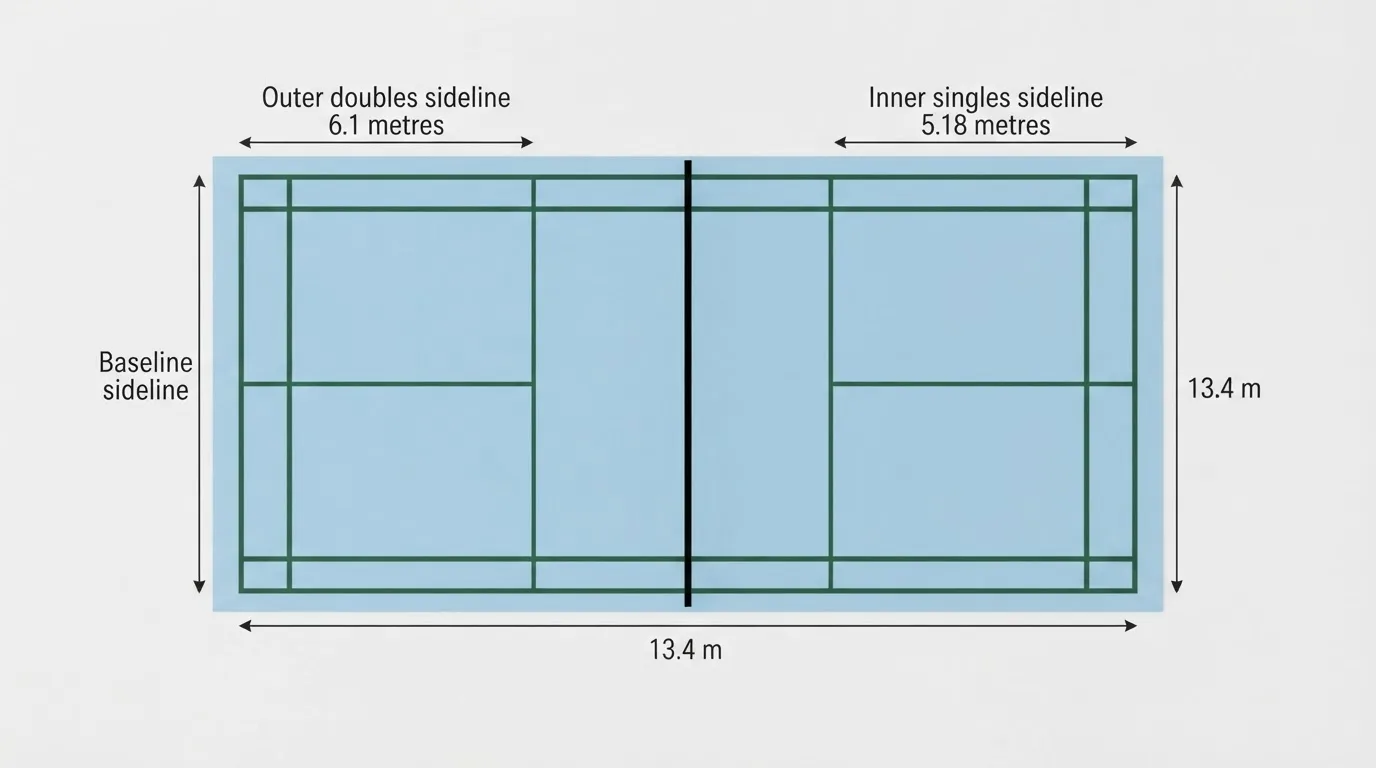
A court is 13.4 metres long. For doubles it is 6.1 metres wide; for singles the tramlines close, leaving a 5.18-metre width. The net is 1.524 metres high at the centre and 1.55 metres at the posts. Five disciplines sit inside the sport: men’s singles, women’s singles, men’s doubles, women’s doubles and mixed doubles. A bookmaker’s menu lists these five as the basic competitive units, plus the team events that sit on top — the Thomas Cup for men’s teams, the Uber Cup for women’s teams and the Sudirman Cup (mixed) — and the Olympic events, which have been part of the Summer Games since 1992, with mixed doubles added four years later. The Badminton World Federation, founded in 1934 as the International Badminton Federation, governs the international calendar.
What this means for a bettor is that any market labelled “match winner” refers to one of those five disciplines, not to a team event unless the bookmaker says so. A “winner” market on the Thomas Cup is settled on the cup final, not on the semi-final the bettor may have watched live. A set-by-line or game-by-game market — sometimes offered by the bigger sportsbooks on the bigger tournaments — refers to individual games within a match, scored to 21 with the deuce rule. A bettor who reads the market name before reading the rules avoids most of the obvious mistakes.
Statutory frame: who is allowed to take your bet in Great Britain
Great Britain has no state monopoly on sports betting and no list of permitted sports or markets. A bookmaker that wants to take bets from customers in Great Britain — by website, by app or by telephone — needs a licence from the Gambling Commission, the non-departmental public body that regulates commercial gambling under the Gambling Act 2005. The Commission issues operating licences in tiers: remote general betting standard (real events) is the standard sportsbook licence; remote betting intermediary is the betting-exchange licence; remote pool betting covers pool products on horse and dog racing. The standard licence covers badminton without further paperwork — the sport is a “real event” and is treated like any other, with no special permission needed.
Three points matter for a bettor shopping for odds. First, a licence is compulsory at the point of consumption: an operator whose remote facilities are used in Great Britain needs a Commission licence wherever it is headquartered. A Curaçao, Gibraltar or Maltese licence is not a substitute. Second, the Commission’s public register is the test of who holds one: anyone can search it by business name, trading name, domain or account number, and the register entry carries the licence number, the licence holder’s legal name, the licensed activities and the trading names the licence covers. Third, several British high-street brands run under one licence holder — Ladbrokes and Coral both sit under LC International Limited, for example, and Paddy Power and Betfair sit together under Flutter — so a “different brand” on the front of the website is not always a “different operator” behind it.
Northern Ireland is outside the 2005 Act. A GB licence does not regulate Northern Ireland, and a brand that is licensed for Great Britain may not, in law, be the right entity to take a bet from a customer in Belfast. In practice most of the operators covered on this page accept customers from Northern Ireland under separate local arrangements, but the technical distinction is the reason “Great Britain” or “GB-licensed” is the right phrase on this page rather than “UK-licensed”.
Financial spread betting is not under the Gambling Commission. Spreadex, for example, is regulated by the Financial Conduct Authority for its spread-betting products and by the Commission for its fixed-odds sportsbook, and the firm is explicit that spread-betting losses can exceed deposits. A bettor who opens a spread-betting account is signing up for a different product with a different regulator and a different risk profile — the winnings and losses are not bounded by the stake in the way a fixed-odds single is.
Responsible gambling: the controls a licensed bookmaker has to offer
Every operator covered on this page takes part in GAMSTOP, the national multi-operator self-exclusion scheme, and runs age and identity verification before a customer can deposit or gamble. Name, address and date of birth are checked before the first deposit; the requirement has been in force since 7 May 2019 and applies even where the first bet is a free bet or bonus. There is no anonymous play at a GB-licensed site, and the verification step is the reason most sign-ups now ask for a driving licence or a passport rather than just an email address.
Since 30 August 2024 a financial vulnerability check has applied to licensed remote betting: when a customer’s deposits minus withdrawals exceed £150 across a rolling 30-day window — a threshold in force since 28 February 2025 — the operator runs a public-record check, looking for markers such as bankruptcy or county court judgments. It is not an income check and it is not a credit-reference check. The threshold is low, which is the point: it catches people in trouble early. A separate tier of “financial risk assessments” has been announced in stages by the Commission, but no start date is published; the right phrase on this page is “announced, staged, no start date”, not “in force”.
Deposit limits sit under the Remote Technical Standards and the operator’s safer-gambling tools. The first changes took effect on 31 October 2025; a second phase was postponed to 30 September 2026, and whether that phase is live at the moment of writing is not established. The point that does hold: there is no state-set ceiling on deposits or losses. A bettor who wants a hard ceiling sets it themselves through the safer-gambling menu, with options for daily, weekly or monthly limits. Time-outs, reality checks and full self-exclusion are universal across the operators covered below.
Help is not just the operator. GamCare runs the National Gambling Helpline; GambleAware funds treatment and education; the NHS runs specialist gambling clinics in several regions; Gamblers Anonymous runs peer-led meetings. Every licensed site links to these from a responsible-gambling footer. Offshore, none of this applies: no GAMSTOP coverage, no Commission complaints route, no approved alternative-dispute-resolution body, and no British consumer redress if funds are withheld. The loss of protection is the practical price of bypassing the licence, not a technicality.
Offers and bonuses: what “free bets” actually cost
Every welcome offer in this market carries the word “free” in its headline. The word is a marketing choice, not an arithmetic one, and the cost sits inside the small print. A “free bet” is a token that lets a bettor place a wager without risking their own cash, but the stake is usually not returned with a winning bet — the bookmaker keeps the £10 free bet and pays out only the profit. A “bonus” is a token that works in the same way, sometimes with a wagering requirement on top: the bonus has to be turned over a number of times before any winnings become withdrawable cash. The headline number is the marketing number; the requirement is the price.
The promotion rules in force since 19 January 2026 cap wagering requirements at 10x. A £10 bonus with a 50x requirement would now need £500 of qualifying bets before withdrawal; under the cap, no more than £100 of qualifying bets is required. Mixed-product promotions — an offer that conditions the bonus on activity across two or more product types, such as “bet on football to unlock free spins” — are banned. Whether the cap applies to a free bet with no wagering condition, and whether the cap places any ceiling on the cash value of a bonus, are not established in the public rules. The right framing is that the cap tightens the worst cases, not that it cleanses every offer.
Some examples on this page, in qualitative form, to show what the offers look like in practice:
- Unibet’s headline is the deposit-and-bet form: deposit and place a sports bet of £20 or more at minimum odds of 2.0 (1/1), and receive £40 in free bets, expiring within seven days of issue. The 2.0 floor matters — a qualifying bet at shorter odds does not trigger the offer, and a bettor who fails to clear the requirement inside seven days loses the free bets outright.
- Bet Ahoy’s headline splits the credit: a £5 sports free bet and a £5 accumulator free bet, issued on a £10 qualifying bet. Two tokens, two expiry windows, one bonus.
- Hollywoodbets’ headline is the refund form: a first qualifying losing accumulator — stake £10 or more, three legs or more, odds of 4/1 (5.00) or greater, settled within seven days — returns the stake as a free bet of up to £30. The “up to” cap matters: an accumulator that loses at odds of 100/1 still returns a £30 free bet, not the full stake.
- Fitzwilliam Sports’ headline is a high-stakes welcome, gated by compliance criteria and open to a capped membership only. The barrier is not the deposit, it is the membership.
The pattern, across the offer set, is that the headline number is roughly twice the qualifying stake. The price of that headline is the qualifying bet at a floor (Unibet 2.0, Hollywoodbets 4/1), the short expiry window (Unibet seven days, Hollywoodbets seven days), and the stake-not-returned rule on the free bet itself. A bettor who claims four welcome offers in a row is doing roughly £80 of qualifying bets at the floor odds to clear £160 of free bets, and is paying the bookmaker’s margin on every qualifying bet as it goes through. The offer is “free” only in the sense that the qualifying stake is returned if the bet wins; on a losing qualifying bet, the offer pays out, but the offer also depends on a loss to trigger it.
No code, voucher or promo token is printed anywhere on this page. Every operator routes offers through its own account page, app or marketing email, and any token that exists today may not exist by the time the page is read.
Live badminton betting and cash out
Live betting on badminton is offered by the bigger sportsbooks. In-play menus typically open for the BWF World Tour events, the All England Open and the Olympic badminton programme, and they sit alongside the same operator’s tennis and table-tennis in-play pages. The structural feature of the sport — short games, two-minute changeovers, and points won or lost in single shots — makes for a fast-moving market and a thinner one. Liquidity on an in-play badminton game is lower than on an in-play tennis match at the same level, and the suspension of markets between games is sharper than in tennis because the points are shorter.
Cash out is the operator’s offer to settle a bet before the event has finished, at a price the operator sets in real time. The price is not negotiable. The bettor sees a number, accepts it, and the bet is closed; the bettor keeps the cash-out value and forfeits the rest of the position. On a badminton match winner market the cash-out price is generally offered at the end of each game rather than during it, because the operator’s model is uncertain about the value of a single game in progress. On a game-by-game market the cash-out window is wider, because the game is itself the unit of settlement.
bet365 is the standard reference point for in-play and streaming on badminton, with a Bet Builder+ product that combines markets from one event into a single bet and is available pre-match and in-play; Match Live and a Live Golf Tracker are advertised as ways to follow bets in play on the bigger sportsbooks. Streaming of badminton events is offered by some operators but is gated by geography, account standing and the simple fact that some rights holders do not allow their feed to be carried on a betting site. A bettor who wants live pictures of the All England Open should not assume the operator’s player will be showing them.
The thinness of the in-play product is itself information. Where tennis in-play on the bigger bookmakers carries six or seven markets per game (match winner, set winner, next game, total games, handicap, method of victory, race to N), badminton in-play on the same bookmaker typically carries two or three (match winner, sometimes game winner, occasionally total points). The bettor who is used to the tennis menu and approaches badminton in the same way should expect a thinner page.
Predictions and strategy: what kind of edge is even possible
No system wins at badminton betting, and the page ahead does not contain one. A system that wins does not exist, and a system that looks like it wins is being read on the losing side of variance. The honest framing is that the edge, if any, sits in the work the reader is willing to put in before the bet is placed.
Three sources of pre-match information carry weight in this market. First, head-to-head records, which on the BWF World Tour go back years and are indexed on the federation’s tournament pages. Two players who have met fifteen times in two seasons are a small sample but a real one, and the match-up favours one of them more often than not. Second, recent form, which on the World Tour is updated weekly and which feeds into the bookmaker’s prices anyway; the edge is in the timing of the read. Third, surface and venue — badminton is played indoors, so surface is largely neutralised, but altitude and venue type matter for the Sudirman Cup and the Thomas/Uber events in Asia.
In-running, the relevant information is the scoreboard and the change of ends. There is no pitch report to read, no wind to factor, and no referee to second-guess. The bettor who is watching the match has roughly the same information as the trader setting the in-play price. The edge, in the rare case it exists at all, sits in the discipline of betting only when the offered price is better than the bettor’s own estimate of fair value. That discipline is dull, unglamorous and works over months, not over a single match.
Stats software — the kind of tool that scrapes BWF results into a database and produces ELO ratings or head-to-head summaries — is useful for the bettor who wants to put a number on a player before the bookmaker’s price moves. It is not, on its own, an edge. The same data feeds the bookmaker’s models as well. What it does is shorten the time it takes to form a view, and time, in a market this thin, is the resource that runs out first.
The single hardest discipline is the one this paragraph cannot enforce for the reader: stop after a loss. A punter who chases a bad beat on the next rally is paying margin twice, on the original bet and on the recovery bet, and the bookmaker’s edge compounds. The right bankroll rule is the boring one — a fixed unit, a fixed percentage, a hard stop — and the right response to a losing day is the same response as to a winning one: walk away.
Bet types and odds: what a betting slip actually offers
A badminton betting slip on a UK-licensed sportsbook offers fewer market types than a tennis or football slip, and the types it offers cluster around the match winner. The basic shape of the menu looks like this in practice:
- Match winner. The player or pair that wins the match. The default market; the one the bookmaker prices first.
- Game winner. The player or pair that wins the current game. Settled on the score at the moment the game is won; offered on selected matches in standard singles and standard doubles.
- Total games. Over/under 2.5 — that is, will the match finish in two games (under) or go to a decider (over)? A 3-player game format means most matches at the top of the game finish in two; the price on “over 2.5 games” reflects that.
- Handicap. A game handicap of ±1.5, equivalent to betting on the winner with a one-game start or deficit; settled inside on the number of games won. A handicap of ±2.5 is unusual at badminton and tends to appear only on the very short-priced favourites.
- Set score. The exact score in games — 2–0 or 2–1 in the match. Settled on the final scoreline; offered on selected events.
- Outright winner. The winner of a tournament, settled on the final. Available weeks ahead of the event on the bigger bookmakers.
Each market carries a margin. The bookmaker’s margin is the slice of every pound staked that the bookmaker keeps on average across all outcomes of a market. It is built into the prices the bettor sees. On a two-way match winner, with each player priced at around 1.90 (9/10), the arithmetic is straightforward: the implied probability of each outcome is roughly 1/1.90, or about 52.6 per cent, and the two together sum to 105.3 per cent — the extra 5.3 per cent is the margin. A bettor who backs either player at those prices is, over many bets, paying 5.3 pence per pound staked to the bookmaker. On a three-way market, such as a tournament outright with three co-favourites at 3.00 (2/1) each, the implied probabilities sum to 100 per cent with no margin; the same three co-favourites at 2.75 (7/4) sum to 109 per cent and the margin is around 8.3 per cent.
The illustrative case this page works with is a two-way market at decimal odds 1.90 / 1.90. The implied probability on each side is 1/1.90, or about 52.63 per cent. The two implied probabilities sum to 105.26 per cent, and the margin is the excess over 100 per cent — in the region of 5.3 per cent. The margin sits inside the price as a percentage the bookmaker keeps on every pound staked on this market over the long run; the bettor’s expected cost, on the same two-way market, is roughly £5.30 per £100 staked.
In fractional odds the same two-way market reads 9/10 against each side: a £10 stake returns £19 — the £10 stake plus £9 profit. In decimal, the £10 stake at 1.90 returns £19. The two formats are not different prices; they are the same price written in two notations, and the conversion is a/b → a ÷ b + 1. Fractional 5/1 is decimal 6.00; fractional 11/4 is decimal 3.75; fractional evens (1/1) is decimal 2.00. UK bookmakers display fractional odds by default; the betting exchanges and most international sportsbooks display decimals.
Combination bets work the same way as in any other sport. A double multiplies the two prices into one, a treble multiplies three, an accumulator (“acca”) multiplies four or more. The combined price is the product of the legs, and the margin compounds with each leg. An acca of three legs at 1.90 each multiplies into 6.859 — the combined price is the same as a single bet at 6.86 — and the margin on the acca is higher than the margin on any one leg, because the bookmaker has built a margin into each leg. Bet Builder+ and same-game-multi products at bet365 combine markets from a single event into a single bet and are available pre-match and in-play; the trade-off is correlation — the bookmaker’s model already knows that winning the first game correlates with winning the match, and the combined price reflects that.
Each-way betting, a horse-racing convention that has migrated to selected other sports, is rarely offered on badminton because the place terms do not translate. The “place” in a badminton match is meaningless; there is no equivalent of “each-way” on the outright winner market. A bettor who sees an “each-way” option on a badminton event is looking at a market that has been copied across from a template and is likely to settle the place portion at the same odds as the win.
Tournaments, fixtures and disciplines
The badminton calendar runs almost year-round. The headline events a bettor will see on a UK bookmaker’s outright market are the All England Open (first held in 1900), the BWF World Championships (first held in 1977 and held every year apart from the Olympic year), the Thomas Cup and Uber Cup (men’s and women’s team championships, held every two years) and the Sudirman Cup (mixed team, also every two years). The Olympic badminton programme runs in the Summer Games; the next edition sits within the Games’ four-year cycle.
The BWF World Tour is the year-long series that sits underneath those flagships. It breaks into tiers — Super 1000, Super 750, Super 500, Super 300 and Super 100 — and the bigger the tier, the more events a bookmaker tends to price, the deeper the in-play menu, and the tighter the margin on the match-winner market. A Super 1000 event such as the All England Open or the Indonesia Open will typically carry outright, match winner, handicap and total games markets on every game of the draw; a Super 100 event will carry outright and match winner on the back end of the draw, with the early rounds settled before the price is updated.
The five disciplines — men’s singles, women’s singles, men’s doubles, women’s doubles and mixed doubles — each carry their own outright markets. Men’s singles is the deepest market, with outright pricing typically available from the quarter-final stage onwards. Women’s singles is the next deepest. Doubles and mixed doubles tend to be priced only on the bigger tournaments and only from the semi-finals onwards. A bettor who wants doubles outrights on a regular basis is going to be looking at a thinner menu than the singles punter, and the in-play product on doubles is thinner still.
The team events — Thomas, Uber and Sudirman — settle on the final result of the tie, which in badminton is the best of five matches across the disciplines. A bet on “England to win the Sudirman Cup” is a bet on the team, not on any individual player, and is settled on the final score of the tie. The format matters: a 3–2 win counts as a win, but the bettor who also takes a “correct score” market needs the same 3–2 line that the bookmaker is offering.
Fixtures and live scores feed in from the BWF’s data feed, which the bigger bookmakers subscribe to. The feed carries the schedule, the in-progress scores and the final results. Smaller bookmakers may rely on a third-party feed that updates less frequently, and a price suspended on the back of an out-of-date score is the kind of practical problem a bettor runs into when the operator’s data plumbing is slower than the match.
Where each UK-licensed bookmaker sits on badminton
| Brand | Licence and Holder | Offer |
|---|---|---|
| Ladbrokes | 054743-R-330863-014 (LC International Limited) | Outright on big tournaments; match winner from QF |
| Bet Ahoy | 100094-R-341742-003 (Bet Ahoy Ltd) | Outright on headline events; match winner on selected matches |
| Fitzwilliam Sports | 048760-R-335434-009 (SBKI Limited) | High-stakes welcome gated by compliance criteria |
| London Bet | 066162-R-340278-004 (Thistle Bet Limited) | Shallow badminton market depth; casino-focused |
| Unibet | 045322-R-324275-019 (Platinum Gaming Limited) | Outright on World Tour events; match/game-winner/total-games |
| Smarkets | 039173-R-319366-011 (Smarkets (Malta) Limited) | Betting exchange; fastest payment plumbing |
| Fafabet | 057385-R-333191-006 (Taichi Tech Limited) | Modest depth; outright on bigger tournaments |
| bet365 | 055148-R-331498-002 (Hillside (UK Sports) ENC) | Deep menu; Bet Builder+, live streaming, in-play |
| Hollywoodbets | 053028-R-330019-013 (Hollywoodbets International UK Limited) | Moderate depth; accumulator refund welcome |
| Kalooki Sportsbook | 057730-R-333396-005 (Kalooki Sportsbook Limited) | Modest depth; outright on headline events |
The set that follows is a description of the bookmakers on the Gambling Commission’s public register that take bets on badminton, in the order the register and the comparison ahead use. Each entry carries the licence, the licence holder and the brand’s own offer on the sport. None of the licences is “the only” one, none of the operators is “the best”, and the order is descriptive, not a ranking. A bettor should treat each licence number as the thing to check on the Commission’s register before opening an account, because the licence is the only piece of the picture the register can verify.
Ladbrokes — the high-street benchmark with a thin badminton menu
Ladbrokes runs on a Gambling Commission remote licence held by LC International Limited under account 54743, and the GB App Store listing for the Ladbrokes Sports Betting App carries a rating of 4.66 from 101,255 ratings — a measure of how widely the app is used, not a measure of its badminton product. The brand sits under the same corporate roof as Coral, and the betting menu is shared across the two brands in most respects. On badminton the depth of the menu is the depth of a generalist: outright on the bigger tournaments, match winner on the World Tour events from the quarter-finals, and a thin in-play page. Ladbrokes’ strength on badminton is the size of the customer base and the depth of the liquidity on the Premier League football markets; that strength does not flow into a Super 300 badminton event.
Bet Ahoy — a thin welcome with a two-token split
Bet Ahoy runs on a Commission licence under account 100094, held by Bet Ahoy Ltd. Its welcome splits the credit: a £5 sports free bet and a £5 acca free bet, issued against a £10 qualifying bet. Two tokens, two expiry windows, and a thinner offering than the bigger sportsbooks. The brand is a smaller operator in the market and its badminton menu is accordingly thinner — outright on the headline events, match winner on selected matches, and limited in-play.
Fitzwilliam Sports — the Dublin bookmaker with a gated welcome
Fitzwilliam Sports runs on a Commission licence under account 48760, held by SBKI Limited, and the brand describes itself as a Dublin bookmaker with capped membership and a “High Stakes Welcome” gated by compliance criteria. The welcome is not a sign-up offer in the conventional sense; it is a tier of membership available to a small number of customers who meet the firm’s criteria. Safer-gambling tools — instant deposits, fast withdrawals, timeouts and deposit limits — are advertised, alongside links to GambleAware, GamStop and Gamblers Anonymous.
London Bet — the casino-plus-sportsbook hybrid
London Bet runs on a Commission licence under account 66162, held by Thistle Bet Limited. The app combines sports betting on football, tennis, horse racing, greyhounds, darts, golf, cricket, NFL, NBA, MLB and snooker with Pragmatic Play casino slots and live in-play betting. Badminton is on the sportsbook menu; the depth is shallow, the in-play page is thin, and the strength of the product is the casino side. A bettor looking for a casino-plus-sportsbook in one app will find London Bet; a bettor looking for a deep badminton menu will not.
Unibet — the deep menu with a £40 welcome against a £20 qualifying bet
Unibet runs on a Commission licence under account 45322, held by Platinum Gaming Limited, Gibraltar, and the brand states it has operated since 1999. The headline welcome is a deposit-and-bet offer — deposit and bet £20 on sports at minimum odds of 2.0 (1/1) and receive £40 in free bets, expiring within seven days of issue, for new GB customers using a debit card or instant bank transfer. The free-bet stake is not returned on a winning bet. Unibet’s badminton menu sits in the upper half of the comparison: outright on the World Tour events, match winner on most matches, and game-winner and total-games markets on the bigger fixtures. The strength is depth, the weakness is the seven-day expiry.
Smarkets — the exchange with the fastest payout plumbing
Smarkets runs on a Commission licence under account 39173, held by Smarkets (Malta) Limited, as a remote betting intermediary — the licence class for betting exchanges. The platform runs a sportsbook alongside the exchange, but the exchange is the main event. UK open-bank-transfer deposits are instant from £10 to £10,000; UK debit card deposits are instant from £10 to £15,000; withdrawals are processed within six hours from £10 to £100,000. The payment plumbing is the strongest part of the picture; the badminton market depth on the exchange sits behind the bigger exchanges on tennis and the bigger sportsbooks on outrights.
Fafabet — the smaller bookmaker with Best Odds Guaranteed on horse racing
Fafabet runs on a Commission licence under account 57385, held by Taichi Tech Limited. The headline product is Best Odds Guaranteed on UK and Irish horse racing win and each-way bets from 9am on race days: if the starting price is bigger than the price taken, the bigger odds are paid. Badminton sits on the sportsbook menu; the depth is modest, the outright markets are priced on the bigger tournaments, and the in-play product is thin.
bet365 — the deep menu and the streaming standard
bet365 runs on a Commission licence under account 55148, held by Hillside (UK Sports) ENC, and the GB App Store listing describes the app as the most-downloaded sports-betting app in the UK. The brand is the official global betting partner of the UEFA Champions League and carries a deep sportsbook product across most sports, including badminton. On badminton the menu runs deep: outrights on the World Tour events, match winner on most matches, handicap and total games on selected events, and an in-play product with Bet Builder+, Super Boosts, Winnings Boosts on Bet Builders and selected singles, plus daily Bet Boosts. Live streaming of events worldwide is offered, alongside in-play betting, Match Live, Bet Track and a Live Golf Tracker. The badminton streaming coverage is thinner than football or tennis, but the in-play and combination product is the strongest of the operators on this page.
Hollywoodbets — the accumulator-refund welcome
Hollywoodbets runs on a Commission licence under account 53028, held by Hollywoodbets International UK Limited. The headline welcome is a refund on the first losing qualifying accumulator of £10 or more, three legs or more, odds of 4/1 (5.00) or greater, settled within seven days. The refund is paid as a free bet of up to £30 — the “up to” cap is the meaningful part of the wording, because the refund does not scale with the stake. One free bet per customer. The sportsbook depth on badminton is moderate.
Kalooki Sportsbook — the small operator with a clear licence picture
Kalooki Sportsbook runs on a Commission licence under account 57730, held by Kalooki Sportsbook Limited (company number 12938274), and the brand is a GAMSTOP member. The brand is a smaller operator in the market and the badminton menu is accordingly modest — outright on the headline events, match winner on selected matches. The licence picture is the cleanest in the comparison, and the safer-gambling wiring (GAMSTOP, age verification, identity checks before first deposit) is in line with the rest of the licensed brands.
The margin of a market: how the bookmaker’s edge shows up in the price
The margin is the share of every pound staked that the bookmaker keeps on average across all outcomes of a market. The arithmetic is the same on every two-way market and is straightforward to reproduce. For a two-way market with decimal odds of d₁ and d₂ on the two outcomes, the implied probability of each outcome is 1/d₁ and 1/d₂, the sum of the two is the “overround”, and the margin is the overround minus 1 (or 100 per cent).
The illustrative case used on this page is a two-way market at decimal odds of 1.90 and 1.90 — the kind of even-money match-up a bookmaker might post on a tight badminton game. The implied probability on each side is 1/1.90, which works out to roughly 52.63 per cent. The two implied probabilities sum to roughly 105.26 per cent, and the margin sits in the gap between that figure and 100 per cent. The margin is therefore in the region of 5.3 per cent. A bettor staking £10 on each side at those prices is risking £20 and is guaranteed £19 back on one of the bets if it wins, the loss is £1 across the two bets, and that £1 is 5 per cent of the £20 total stake.
In fractional odds, the same two-way market reads 9/10 against each side. A £10 stake on each side returns £19 on the winning bet, and the £1 shortfall on a winning pair is the same £1 / £20, or 5 per cent. The fractional and decimal prices describe the same edge; they just describe it in different notations.
On a three-way market — say, an outright tournament with three co-favourites each priced at decimal 3.00 (2/1) — the implied probabilities sum to 100 per cent and the margin is zero, in theory. In practice the three co-favourites are rarely all priced at the same number, and the bookmaker builds a margin into the discrepancy. If the three are priced at 2.75 (7/4) each, the implied probabilities sum to roughly 109 per cent, and the margin is around 8.3 per cent. On a one-way tournament outright with twenty priced runners, the sum of the implied probabilities runs from about 108 per cent to about 115 per cent, depending on the bookmaker, and the bigger the field the larger the typical margin because the bookmaker has more runners to balance.
The takeaway is the one every price carries: the margin sits inside the price the bettor sees, and a price at 1.90 is not the same value as a price at 1.95, even though the difference looks small. Over many bets, the difference between a 5 per cent margin and a 7 per cent margin on the same market is the difference between paying £5 and paying £7 on every £100 staked. The bettor who reads the price also reads the margin, because the margin is what the price is hiding.
Advertising rules and the rules around bonus marketing
Advertising of gambling in Great Britain is not licensed by the Gambling Commission. It runs through the CAP Code (non-broadcast) and the BCAP Code (broadcast), enforced by the Advertising Standards Authority, alongside the LCCP marketing conditions that bind licensed operators. CAP Code section 16 sets the tone: marketing must be socially responsible, must not have strong appeal to under-18s, and no one who is or seems to be under 25 may be featured gambling or play a significant role (with an exception for marketing placed where a bet can be made directly). That rule is about who may appear in the advertisement; it is not a rule about who may bet. The minimum age to bet is 18.
“Winner-to-winner” or “whistle-to-whistle” is an industry code rather than law. Since 1 August 2019 betting advertisements have not been shown on television from five minutes before a live sporting event to five minutes after it, before the 9pm watershed, with horse and greyhound racing excluded. The Premier League clubs’ voluntary withdrawal of gambling sponsorship from the front of matchday shirts, from the 2026/27 season onwards, is voluntary and is not a state-set rule.
The promotion rules in force since 19 January 2026 cap wagering requirements at 10x and ban mixed-product promotions. The cap is the meaningful change: a £10 bonus with a 50x requirement would have needed £500 of qualifying bets before withdrawal; under the cap the requirement is no more than £100 of qualifying bets. The cap does not, by itself, change the stake-not-returned convention on free bets, and the cap does not place a ceiling on the cash value of a bonus. The marketing word is “free”; the rule is the cap.
Operators are responsible for marketing carried out by their affiliates. A bettor who signs up through an affiliate link and finds the welcome offer does not match the headline is, in the first instance, dealing with the operator, not the affiliate. The right step is to check the operator’s own terms page on the day of signing up, because the headline offer and the small print can drift out of sync.
Tax: what the player pays and what the operator pays
The player pays no tax on betting winnings in Great Britain, in the ordinary course. A professional gambler — someone whose betting is a trade rather than a hobby — should ask HMRC or an adviser, because the line between casual play and trade gets drawn by HMRC, not by the bookmaker. The general information is that winnings from fixed-odds and pool betting on sporting events are not taxable to the customer.
The operator pays General Betting Duty, currently 15 per cent on gross profits from general betting (the difference between stakes received and winnings paid). A new remote betting rate of 25 per cent takes effect on 1 April 2027 within General Betting Duty, while remote bets on UK horse racing, self-service betting terminal bets in licensed premises, pool betting and in-person betting stay at 15 per cent. Until 1 April 2027 the remote rate stays at 15 per cent; whether operators pass duty on through odds is not established, and the right framing is that duty is the operator’s tax, not the player’s. Spread betting has its own rates: 3 per cent on financial spread bets and 10 per cent on other spread bets.
The Commission’s statutory levy is a separate charge paid by operators to fund the regulator’s work; it is not a tax on the player and it does not change the price on a betting slip.
The unlicensed option, and why it is the wrong trade
A bookmaker licensed in Curaçao, Malta or Gibraltar, with no Commission licence, can still advertise to UK customers through search-engine and affiliate channels. The 2014 Act made a GB licence compulsory at the point of consumption, and providing gambling facilities in Great Britain without one is an offence under section 33 of the Gambling Act 2005 — aimed at the operator, not the customer. The customer is not prosecuted for using an unlicensed site, and the framing on this page is not a legal one; it is a practical one.
The practical price is the loss of protection. An unlicensed site does not run GAMSTOP enrolment; an unlicensed site does not run age or identity verification before the first deposit (and a customer who has self-excluded through GAMSTOP can find a workaround on an unlicensed site); an unlicensed site is not bound by the 10x bonus cap; an unlicensed site is not bound by the £150 financial vulnerability check. There is no British consumer redress if funds are withheld, and there is no Commission complaints route. If the site disappears, the funds disappear with it.
Enforcement against unlicensed operators is disruption, not blocking: cease-and-desist notices, search-engine referrals, registrar and host work and payment-provider pressure. Court-order DNS blocking powers have been granted or are about to be granted; ISP-level blocking is not in operation. The honest framing: licensed = checks, limits, GAMSTOP, the bonus cap, and British consumer redress; unlicensed = none of those protections and a real risk of loss of funds. Neither side of that trade is “the safe choice” by default, and a reader who treats the choice as costless is not seeing the price.
Frequently asked questions
How does a bettor actually place a bet on badminton?
A bettor opens an account with a UK-licensed bookmaker — by downloading the app or visiting the site, completing age and identity verification, and depositing by debit card or bank transfer — then opens the badminton section of the sportsbook, picks a match or tournament, selects a market (match winner, game winner, total games, handicap, outright), enters a stake, and confirms the bet. The bet is settled on the result of the market at the end of the event. Settled bets are paid into the cash balance; winning bets on free-bet stakes usually pay profit only, not stake.
How can a bettor check that a bookmaker holds a Gambling Commission licence?
The Commission’s public register can be searched by business name, trading name, domain or account number, and it is the whole test of who holds a licence. The register entry carries the licence number, the licence holder’s legal name, the licensed activities and the trading names the licence covers. A reader who is checking a brand against this page should match the licence holder’s name and the account number, not just the trading name on the website, since one licence can cover several trading names. The Commission’s own pages on this subject are the place to start.
How is the return on a bet worked out from the stake and the odds?
Return equals stake multiplied by decimal odds. On a £10 stake at decimal odds 2.50, the return is £25; the profit is £15, because the £10 stake is returned with the win. On the same bet at fractional odds of 3/2, the return is also £25 (£10 stake plus £15 profit). On a combination bet, the legs multiply into a single price; a treble with legs at 1.50, 2.00 and 3.00 multiplies into 9.00, and the return is stake multiplied by 9.00.
What is the bookmaker’s margin and how does it show up in the odds?
The margin is the share of every pound staked that the bookmaker keeps on average across all outcomes of a market. On a two-way market with each side priced at decimal 1.90, the implied probabilities are roughly 52.6 per cent on each side and sum to about 105.3 per cent; the margin is the 5.3 per cent excess. The margin sits inside the price, and a bettor who backs the same market at decimal 1.95 (rather than 1.90) is paying a lower margin and keeping more of the stake over many bets.
How do fractional odds such as 5/1 convert to decimal odds such as 6.00?
Fractional odds a/b convert to decimal odds of a ÷ b + 1. Fractional 5/1 is decimal 6.00 (5 ÷ 1 + 1); fractional 11/4 is decimal 3.75 (11 ÷ 4 + 1); fractional evens (1/1) is decimal 2.00 (1 ÷ 1 + 1). UK bookmakers display fractional odds by default; betting exchanges and most international sportsbooks display decimals. The two notations describe the same price and the same edge, only the format differs.
Which tools for controlling play does a licensed bookmaker have to offer?
A licensed bookmaker has to offer GAMSTOP enrolment for self-exclusion (six months, one year, five years, or five years with auto-renewal), deposit limits set by the customer, time-outs and reality checks. Age and identity verification run before the first deposit; a financial vulnerability check runs once deposits minus withdrawals exceed £150 across a rolling 30-day window. Help is available through GamCare (National Gambling Helpline), GambleAware, the NHS gambling clinics and Gamblers Anonymous; every licensed site links to these from a responsible-gambling footer.
Tennis, darts & cue sports – Legalbettinguk.com
Content created by the «Legalbettinguk.com» team
