Chess betting odds in 2026
 Available in US
Data current as of 30. October 2026, checked against the Gambling Commission’s public register for Great Britain.
Chess sits in an odd corner of the sportsbook. The same book that prices Premier League corners and Ashes runs also prices a Candidates final, and the odds on offer are decimal, in pounds, settled the moment a flag falls. What changes between football and chess is the structure of the market and the depth of the price. Football draws 1X2 liquidity from a hundred leagues; a World Chess Championship match may get a dozen prices a day, and the difference between two of them can be the bookmaker’s entire take. The rest of this page walks through what those odds look like, how the bookmaker’s margin is hidden inside them, where the regulator sits, who takes the bets, and what to watch when the move is in play.
The landscape of chess betting in 2026
Chess betting is a small corner of a much larger market. Most of the volume runs through the headline events on the FIDE calendar: the World Chess Championship cycle, the Candidates Tournament that decides a challenger, the Grand Prix series, the Olympiad in even years, and the major open events such as Wijk aan Zee, Stavanger, Sinquefield and the US Championship. The Twenty-One Rules of Chess (FIDE Handbook) are the framework every licensed bookmaker settles on, and any price offered on a draw is a price on a real outcome that the laws of the sport actually deliver.
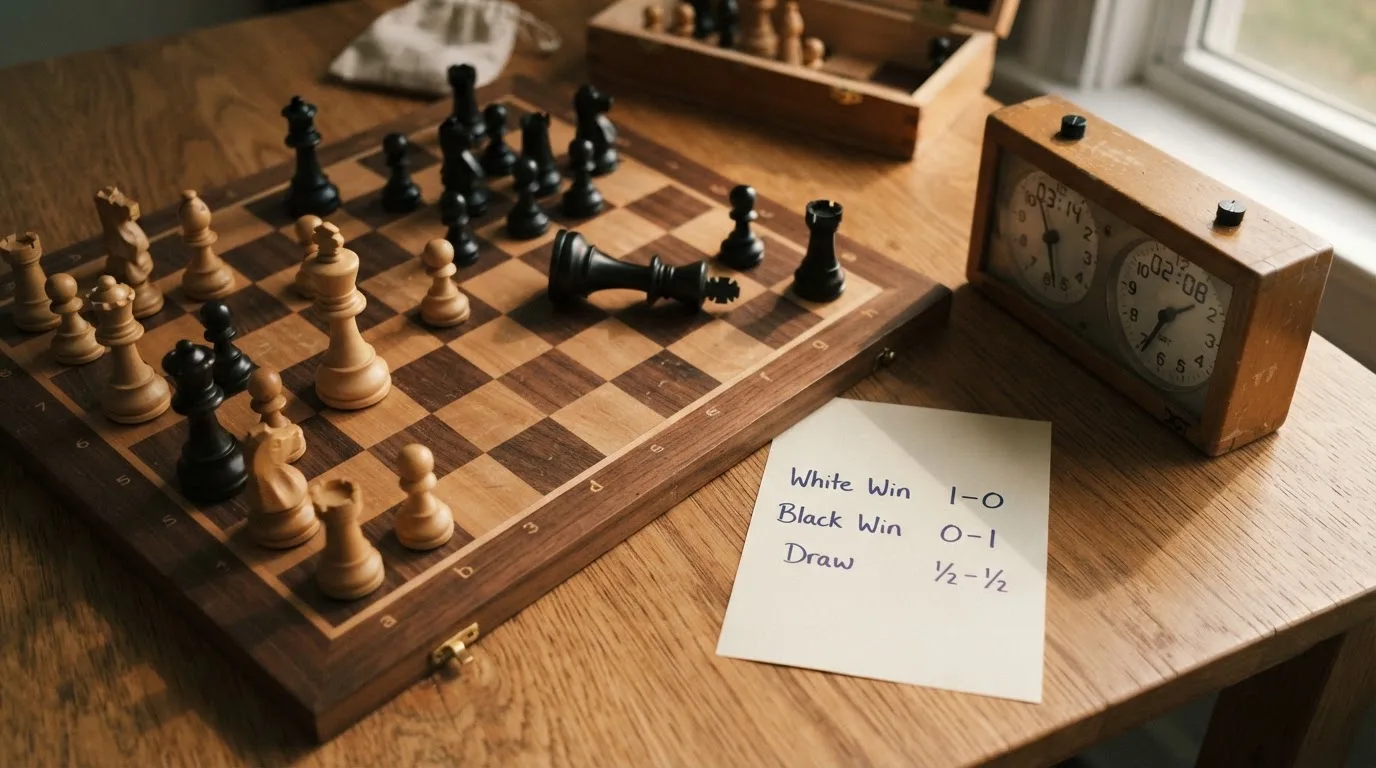
What makes chess odds their own subject is the result itself. A game is recorded as 1–0 for a White win, 0–1 for a Black win, and ½–½ for a draw, and a match is the sum of those scores. Three outcomes on a single game, and a best-of-N match where each game is a fresh three-way market: a market structure that any bookmaker can price, but few price tightly because the betting public is thin compared with football. The price the customer sees reflects that thinness, and so does the margin the bookmaker keeps.
Most UK-licensed bookmakers carry chess in some form. A handful run a year-round outright book on the World Championship and the Candidates; most add markets only when a tier-one event is in progress, sometimes just a match-winner market and a total games line. The price is in decimal, settled at the conclusion of the game or match, and the stake is the only thing the customer risks. Some bookmakers price chess the same way they price any other sport. Some carry it only as a specialism during the FIDE cycle, and pull the markets the moment the trophy is handed over.
The fixtur of the game the odds are set on
A chess game is played on an 8×8 board of 64 squares, with each player controlling 16 pieces. The setup is fixed at the start, the king moves one square in any direction, the rook any number of squares on the file or rank, the bishop any number on its colour, the queen combines rook and bishop, the knight jumps in an L, and the pawn advances one square (or two from its starting square) and captures diagonally. Castling moves the king two squares towards a rook and the rook to the square the king crossed, provided neither piece has moved and the squares between are unoccupied and unattacked. Promotion turns a pawn that reaches the eighth rank into any other piece of the same colour. FIDE rules (the Laws of Chess) govern what counts as check, checkmate and stalemate, and the same Handbook governs the time controls under which professional games are played.
A few results settle the betting markets automatically. Under FIDE rules a chess game is drawn by stalemate, by agreement, or by claim of threefold repetition or the fifty-move rule; since 2014 fivefold repetition and a 75-move rule end the game automatically, and a player may claim a draw under the older thresholds first. A checkmate ends the game at once, and a resignation passes the full point to the opponent. Wilhelm Steinitz, the first universally recognised World Chess Champion, claimed the title in 1886; Gukesh Dommaraju won the title in 2024. Between those dates, chess has been played under rules that have not changed in any way that the betting customer needs to think about; what has changed is the speed, the rating system, and the way an event is staged.
The statute and the licence the odds sit inside
A bookmaker who takes a chess bet from a customer in Great Britain needs a Gambling Commission licence. The Commission licenses the whole commercial market under the Gambling Act 2005, which covers Great Britain (England, Scotland and Wales); Northern Ireland is outside the Act and runs on older law, so a GB licence regulates Great Britain and a licence that regulates Northern Ireland is a different thing. Since the Gambling (Licensing and Advertising) Act 2014 an operator whose remote facilities are used in Great Britain needs a Commission licence wherever it is based, and a Curaçao, Maltese or Gibraltar licence is not a substitute. There is no state monopoly and no cap on the number of licences.
The Commission’s public register is the whole test of who holds one. The register is searched by business name, trading name, domain or account number, and the licence number, the licence holder and the licensed activities are listed against each entry. The categories on the register include remote general betting standard (real events), remote general betting standard (virtual events), remote general betting limited, remote pool betting and remote betting intermediary. Chess falls under real events, the same category as any other sport; there is no separate chess licence and no special regulatory class. Financial spread betting, by contrast, is regulated by the Financial Conduct Authority, not the Commission, and a spread betting customer can lose more than the deposit.
Age and identity are settled before the first bet. The minimum age is 18, and since 7 May 2019 the operator verifies name, address and date of birth before a customer can deposit or gamble, including with a free bet or bonus. A bet placed by an unverified account does not stand. A bet placed on a public holiday in another country still has to clear UK verification, and a customer whose documents do not match the payment method does not move past the registration screen.
What may be bet on is wider than the rules of any sport suggest. There is no statutory list of permitted bets or markets; an operator offers markets under its own rules and the Licence Conditions and Codes of Practice. In-play betting is offered on chess by some operators, especially during the World Championship, and the controls are the operator’s licence conditions and customer-protection duties. Virtual events are a separate licence category; esports are treated like any other event; bets on politics, TV shows and novelty markets are offered by GB bookmakers and no statutory prohibition was found. No statutory cap on stakes in chess betting exists: operators set their own maximum stakes and may restrict customers, and a state list of permitted payment methods was not established.
The tax sits on the operator. The player pays no tax on betting winnings in Great Britain, and General Betting Duty is the operator’s tax on gross profits, currently 15%. From 1 April 2027 a new remote betting rate of 25% applies within it; until that date the remote rate stays at 15%, and whether operators pass duty on through the price they offer is not established. Spread betting has its own rates, 3% on financial products and 10% on other spread bets. The Commission’s statutory levy is a separate charge, not a tax on the customer.
Safeguards the licence attaches to the bet
A licence is more than a permission to take bets. Three obligations sit on top of it and run through every chess market the operator offers.
GAMSTOP is the national multi-operator online self-exclusion scheme. It is a mandatory licence condition for online operators since 31 March 2020, with periods of six months, one year, five years, or five years with auto-renewal. After the minimum period, the exclusion stays in place for a further seven years unless the customer asks GAMSTOP to remove it. GAMSTOP covers online sites and apps; betting shops use a separate service. A self-excluded customer cannot open a new account, deposit or place a bet, and the protection extends across the whole licensed online market rather than the one bookmaker the customer has used.
A financial vulnerability check is a public-record check that applies under LCCP condition 3.4.4, in force since 30 August 2024, to licensed remote betting when a customer’s deposits minus withdrawals exceed £150 in a rolling 30 days (since 28 February 2025). It looks for entries such as bankruptcy or county court judgments; it is not an income check and not a credit reference check. Financial risk assessments, the affordability checks the press has been writing about, are announced in a staged plan, with no start date. Deposit limits are a customer-set tool: operators must offer a gross deposit limit on a fixed time frame, the first changes applied since 31 October 2025, a second phase was postponed to 30 September 2026, and whether it is in force is not established. There is no state-set deposit or loss ceiling for betting; the limit is the customer’s choice.
The credit card ban closes one payment route. Since 14 April 2020, LCCP condition 6.1.2 has banned credit cards for gambling in Great Britain, including credit-card-funded payments through an e-wallet. Debit cards and bank-based payments are not covered by that ban, and a customer who tops up an e-wallet with a credit card is, in effect, paying with a credit card for the bet. Identity verification before the first deposit means no anonymous play at a licensed site, and source-of-funds questions at higher spend are normal under the money-laundering rules.
The bonus cap is the newest of the four. Wagering requirements on bonuses are capped at 10x (a £10 bonus at 50x needs £500 of bets; under the cap no more than £100), and mixed-product promotions, an offer that requires gambling on two or more product types such as betting, casino, bingo and lottery, are banned. The cap applies to bonuses with a wagering condition. Whether it applies to free bets with no wagering condition, and any cap on the money value of a bonus, are not established. An offer that asks for a deposit, a bet and a free spin in the same breath is one of the mixed-product promotions the rule ends; the same offer separated into a sports bet and a casino claim is two promotions, not one.
Help sits outside the bookmaker. GamCare runs the National Gambling Helpline. GambleAware funds treatment and education. The NHS runs gambling clinics in a small number of cities. Gamblers Anonymous runs meetings. A customer who feels the betting has gone past the point of fun can call any of them, and a self-excluded account is the strongest single step a customer can take at the bookmaker.
The mobile app and the bettor on a handset
A chess tournament runs over hours, often days, and the bettor who wants to follow it needs the markets open in a pocket. The bookmakers carry their sportsbook through a mobile app on iOS and Android, and the same login unlocks the desktop site, the in-play page, the bet builder and the account page. The bettor on a handset is the bettor the bookmaker is built around, and the app is where most chess bets are placed.
The app’s job is the same as the desktop site’s: take a stake, lock an odds price, settle on a result. A bet placed at 1.85 settles at 1.85, the decimal odds are fixed at the moment the bet is confirmed, and a late move on the board does not change the price the bettor took. The app shows the slip, the price, the maximum stake and the return before the bet is confirmed, and the return is the only number that matters on the screen.
Two app features sit on top of the basic slip. Bet Builder and Bet Builder+ combine markets from a single event into one bet, available pre-match and in-play, and a chess bet builder can pair a match winner with a total games line, or with a draw-no-bet line. Cash Out settles the bet before the event has finished, at a price the bookmaker sets in real time, and a bettor who wants to lock a profit or a loss uses the slip. Match Live and the live tracker follow a game move by move, useful when the bet is on a single game rather than a match. Live streaming is offered by some bookmakers on selected events, more often on football than on chess, and a customer with a funded account can usually watch the chess stream during the World Championship.
A push notification, a fingerprint login and a one-tap deposit are table stakes, not features. A bookmaker that does not offer them is a bookmaker that has not refreshed its app in a year, and a bookmaker that has refreshed its app in a year is the rule rather than the exception. The two risks on a handset are a stale app that does not load the in-play page, and a fingerprint login that is shared across a family device. The bookmaker’s verification covers the account, not the finger that opens it.
Live betting and cash out on a chess match
A chess match moves at the pace of the board, not the pace of a clock on the wall. A single game can take fifteen minutes in a rapid event or seven hours in a classical one, and the price on the next move changes the moment a piece leaves the board. Live chess betting, also called in-play chess betting, is the market that follows the match while it runs: a price on the next game, a price on the match winner, a price on the total games line. The bookmaker who offers in-play on a Candidates match has a different skill set from the one who only offers pre-match.
The in-play price lags the board by a second or two, and the lag is where the edge sits. A customer who can read a position will see a price that has not yet caught up to a sacrifice, a blunder, or a forced draw. A bookmaker who prices in-play well will keep the lag short, and the price will move with the engine evaluation rather than with the live commentary. A bookmaker who prices in-play badly will leave the price stale, and the customer will not have a market to bet into.
Cash Out is the other half of the in-play product. A bet on a chess match winner can be settled before the match is over, at a price the bookmaker sets on the slip. The price is lower than the back price the customer took in most cases, because the bookmaker’s spread is the cost of certainty. A cash-out at £80 on a £50 bet that would have paid £200 is a small win locked in, and a cash-out at £30 on a £50 bet that would have paid nothing is a small loss taken early. The slip tells the customer the cash-out figure before the tap confirms, and the bookmaker can refuse to offer cash out at any moment.
Three risks come with the in-play product. The first is the disconnection: a chess match played on a floor with bad Wi-Fi stalls the live tracker, and a price the customer took on the live page does not arrive in the bookmaker’s settlement queue. The second is the suspension: a bookmaker will pull the in-play market the moment a critical position is reached, and a customer with a slip open will be left holding an unmatched bet. The third is the cash-out cut: a bookmaker that promises a cash-out price but offers a small fraction of the live back price is a bookmaker that prices its own slip, not the market. The trader in the back office is the one who sets the cash-out figure, and the figure is the bookmaker’s margin in another form.
Strategy, predictions and the work of reading a position
There is no system that wins at chess betting. The shape of a match, the form of a player, the head-to-head record, the time control, the colour sequence, the opening repertoire, the engine evaluation, the standings in a round-robin, the prize fund and the venue all matter. None of them is a system, and a customer who treats one of them as a system will lose to the next one. What works on a football coupon does not work on a Candidates final, because football prices are built on volume and chess prices are built on a small market the bookmaker has decided to take a position in.
The most common mistake is to bet on the higher-rated player as if rating were a probability. Elo is a long-run measure, and a player rated 2800 against a player rated 2700 is the favourite, but the favourite is not the winner and the price the bookmaker offers reflects the gap. A second common mistake is to back a player in form without reading the match-up. A player on a six-event winning streak against weaker opposition is not the same player at the Candidates, where every opponent is a 2700-plus and the draw is the most common result at classical time controls. A third is to ignore the colour sequence; a player who gets White in games one and three and Black in games two and four has the slight edge in the match, and a match that is tied after six games with the colours even has a different shape from a match that is tied with the colours skewed.
The honest framing of chess predictions is that they are uncertain. A bookmaker’s margin is wider on chess than on football because the volume is lower, and a wider margin means the price the customer sees already overstates the bookmaker’s confidence in the outcome. The customer who reads the position, watches the live tracker, and picks a market the bookmaker is slow to price is the customer who has a chance of an edge. The customer who reads a tipster, follows a tip on the next World Championship, and stakes a fixed unit on every tip is the customer who pays the bookmaker’s margin on a long run of bets that have already been priced for the bookmaker’s benefit.
A second honest framing is that a tip is not a strategy. Chess tips and chess betting strategies are mostly a repackaging of the form guide, and the form guide is information the bookmaker already has and has already priced. A bet that looks like value because the tipster named it is a bet that has already been priced in, and the tipster’s name is not a number on the slip. The work that pays is the work of reading the position and the price, and that work is not something a paragraph can do for the reader.
The bet types and how the odds settle
Chess markets are simple in structure, and the bet types below cover almost everything a UK-licensed bookmaker offers on a tier-one event.
The match winner is the headline price. A 12-game match between two players is priced on the outright winner, with a draw or a tiebreak as a third outcome at longer odds. A best-of-N match is settled on the result of the final game; a match that ends in a tiebreak is settled as a win for the player who took the tiebreak.
The game winner is a three-way price on a single game: 1 for a White win, 2 for a Black win, X for a draw. The draw is the longest price in classical chess and the shortest in rapid and blitz, because draws are rare at faster time controls.
The total games line is over/under on the number of games in the match. A match priced at over 8.5 games settles over if the match runs to nine or more games, under if it ends in eight. The line moves with the match, and a bookmaker who offers in-play on the total games line has a trader watching the position on every move.
Draw no bet is a two-way price on the match winner, with the stake returned if the match is tied. The price is shorter than the outright match winner because the bookmaker has removed one outcome, and the stake refund is the cost of the shorter price.
Handicap betting on a chess match sets a game handicap, e.g. one player starts the match at +1.5 games. The handicap is added to the match score at the end, and the bet settles on the adjusted result. A handicap of +1.5 on the underdog turns a tied match into a win for the underdog, and the price reflects the handicap.
Correct score is a price on the final match score, e.g. 6.5–5.5 or 7–5. Correct score is a small market, the prices are long, and the bookmaker’s margin is wider because the volume is thin.
Outright tournament winner is a price on a player to win the event, settled on the trophy rather than a single match. The field may be 8 players, 16 players or more, and the price on the favourite reflects the field rather than the head-to-head. The each-way terms on an outright are usually a quarter of the win odds for a place in the top two or four, and the place terms vary by event and by operator.
Each-way betting is two bets of equal stake, the win part and the place part. The stake doubles, and the place terms are the operator’s. On a chess match, the place part is usually the draw or the loser, and the each-way terms are set by the operator in the each-way terms box on the slip.
Bet Builder and Bet Builder+ combine markets from a single event into one bet, available pre-match and in-play. A chess bet builder can pair a match winner with a total games line, or a match winner with a correct-score line. The price multiplies across the legs, and the stake settles on all legs winning.
A combination bet, called an accumulator or acca on a British slip, is a price on two or more independent selections. The price multiplies, the stake is the unit stake, and a losing leg loses the whole bet. A double is two selections, a treble three, a four-fold four, and a Trixie, Patent, Yankee, Lucky 15, Super Yankee, Heinz and Goliath are named combinations the operator prices in the bet builder menu. The total stake on a Lucky 15 at £1 a unit is £15, on a Heinz at £1 a unit is £57, on a Goliath at £1 a unit is £247.
Cash Out is the price the bookmaker offers to settle the bet before the event has finished, and the slip tells the customer the cash-out figure before the tap confirms.
Settlement is the moment the bet is graded. Chess bets are settled when the official result is published, which is at the end of a game or a match, and a bet that is part of a tournament outright is settled when the trophy is handed over. A bet on a game that ends in a dispute is held until the dispute is resolved, and a bet on an event that is abandoned is settled under the operator’s abandoned-event rule, which is in the operator’s terms.
Sports, tournaments and the FIDE calendar the odds track
Chess sits inside a calendar that runs almost year-round. The headline events the bookmaker prices are below; the calendar is the FIDE calendar, and the bookmaker’s outright book is open while the event is in progress and sometimes for weeks before.
The World Chess Championship is the headline event of the cycle. It is a match between the World Champion and the challenger from the Candidates Tournament, played over a fixed number of games. The match is a best-of-N, the result is settled when the match is decided, and the outright book on the World Championship is the longest-running outright in chess. The cycle is multi-year, and the book on the next cycle opens as soon as the trophy is handed over.
The Candidates Tournament is the eight-player event that decides the next challenger. It is a double round-robin, every player plays every other player twice, and the winner is the challenger. The book on the Candidates runs while the event is in progress, and the outright book on the next World Championship is priced off the back of it.
The Grand Prix series is a series of events that feeds rating points and prize money into the cycle. The book on a Grand Prix event is a smaller market, and the outright book on the Grand Prix is open during the series.
The Olympiad is the team event, played every two years. The book on the Olympiad is on the team winner and on individual board medals, and the outright book opens in the run-up to the event.
The major open events (Wijk aan Zee, Stavanger, Sinquefield, the US Championship) are the year-round diet of elite chess. The book on a major open is on the outright winner, and a bookmaker that covers elite chess year-round carries every one of them.
The rapid and blitz events (the World Rapid and Blitz Championship, the Champions Chess Tour) are the time-control side of the calendar. The book is on a single event, the matches are short, and the in-play product is the draw.
Below the elite, the bookmaker’s chess offering is thin. The bookmaker carries the FIDE calendar, not the club scene, and a customer who wants to bet on a club match is usually looking at a specialism on a smaller site. The bookmaker that prices the FIDE cycle and the headline events is the rule; the bookmaker that prices the rest is the exception.
The bookmakers and the licence behind each one
A chess bet is only as safe as the licence behind it. The ten bookmakers below are the set this page reviews, each one a holder of a Gambling Commission remote licence for real events, each one on the Commission’s public register. The licence number, the licence holder and the licensed activities are public record; the table below sets them out alongside what the operator’s own terms state on the chess offering and on the markets around it.
A reminder before the table. The Commission is the regulator; the licence holder is the company the Commission licenses; the site is the trading name the licence is used under. A customer who wants to check a licence types the licence number, the licence holder or the trading name into the Commission’s register, and the register returns the entry. A licence that is not on the register is not a licence. The Commission’s register is the only place a customer needs to look.
| Bookmaker | Licence | Licence holder | Chess and what the operator’s own terms state |
|---|---|---|---|
| Betfred | Gambling Commission remote licence 039544-R-319290-010 (account 39544) | Petfre (Gibraltar) Limited | Sportsbook app published by Done Brothers (Cash Betting) Ltd; covers 21 sports plus over 2,000 casino-style games; chess pricing is the standard sportsbook offer. |
| BetMGM | Gambling Commission remote licence 039198-R-319450-029 (account 39198) | LeoVegas Gaming PLC | Sports welcome is four £10 free bets (two football accumulators of 4+ selections and two sports multiples of 2+) for new UK customers who deposit £10 or more and place a sports bet within 7 days; minimum odds and opt-in apply; free bets valid for 7 days. |
| Bet600 | Gambling Commission remote licence 044731-R-323941-016 (account 44731) | Tyche Tech Limited | Best Odds Guaranteed on horse racing: if the starting price is bigger than the early or show price taken, the bet is paid at the SP. |
| 10bet | Gambling Commission remote licence 043173-R-322899-023 (account 43173) | Blue Star Planet Limited | Sportsbook covers football, tennis and horse racing; Cash Out, Bet Builder and Live Streaming are listed features. |
| DragonBet | Gambling Commission remote licence 064908-R-339041-003 (account 64908) | DragonBet Ltd | App features Welsh football and rugby markets, racing, American football, in-play betting and bet builder markets. |
| Fitzwilliam Sports | Gambling Commission remote licence 048760-R-335434-009 (account 48760) | SBKI Limited | Dublin bookmaker with capped membership; welcome is a High Stakes Welcome subject to compliance criteria; instant deposits, fast withdrawals, timeouts and deposit limits, and links to GambleAware, GAMSTOP and Gamblers Anonymous. |
| Bar One Racing | Gambling Commission remote licence 056516-R-332750-007 (account 56516) | Bar-One Racing Limited | Irish independent bookmaker, rebranded as BAR 1 Betting, with shops across Ireland and horse racing sponsorships at Dundalk, Fairyhouse, Navan, The Curragh, Curraheen Park and Cork. |
| Midnite | Gambling Commission remote licence 101839-R-342850-001 (account 101839) | Midnite Limited | Site cites Gambling Commission licence 101839 and shows in-play events, an acca builder, popular accas and price boosts with maximum-stake limits; sports welcome is £25 in free bets and 50 free spins for new customers who bet £5 or more on pre-match odds of EVS (2.0) or greater within 14 days of sign-up, free bets valid for 7 days. |
| Paddy Power | Gambling Commission remote licence 039439-R-319330-013 (account 39439) | PPB Counterparty Services Limited | Sports Betting app published by Paddy Power PLC; covers football, horse racing, boxing, rugby, tennis, golf, darts, snooker and F1. |
| NetBet | Gambling Commission remote licence 039170-R-319343-032 (account 39170) | Netbet Enterprises Limited | Daily Boosts, Profit Boosts and free bet offers, a Bet Builder with instant dynamic odds, and sports stats for major leagues. |
What the bookmakers do on chess specifically
Chess is a thin market for most of the year, and the offering above is what the operators say on their sportsbook home pages and in their app store descriptions. A few patterns hold across the set.
The headline events are covered by most of the ten. The World Chess Championship cycle and the Candidates Tournament are the events the bookmakers price, and the outright book is open in the run-up to each one. The match-winner market, the correct-score market and the total games line are the three core markets on a tier-one event, and most of the ten offer all three during a championship match.
The year-round offering is thinner. The major opens (Wijk aan Zee, Stavanger, Sinquefield, the US Championship) are priced by some of the ten and not by others, and the chess calendar below the elite is largely unserved. A customer who wants to bet on a club match is looking at a specialism on a smaller site, and a customer who wants to bet on the Olympiad is looking at a bookmaker who carries the team event.
The in-play product is the differentiator. The bookmakers who carry in-play on a championship match are the bookmakers with a trader watching the position; the bookmakers who do not are the bookmakers who only price the match pre-play. The bet builder on chess is a smaller product than the bet builder on football, and the bookmakers who offer it on chess are the bookmakers with a deeper chess offering.
The bonus cap is the rule, not the exception. The 10x cap on wagering requirements and the ban on mixed-product promotions apply to every bookmaker on the register, and the welcome offers above are the kind of offers that sit inside the cap. The free bets the operators describe are the kind of free bets whose stake is not paid back with a win, and the value of a free bet is the value of the bet, not the value of the stake.
How the bookmaker’s margin is built into the odds
The bookmaker’s margin is the slice of every pound staked that the bookmaker keeps on a market, and it is hidden inside the odds on the slip. A bookmaker who offers 1.91 on White, 1.91 on Black and 1.91 on a draw on a single game is not offering a fair price; the price implies a probability on each outcome, and the implied probabilities add up to more than 100%. The gap between the sum and 100% is the bookmaker’s margin.
The arithmetic is the same on every market. Take an illustrative two-way market at decimal odds 1.90 / 1.90 (fractional 9/10), a coin-toss price with no margin taken out. The implied probability on each side is 1 ÷ 1.90, which is about 52.63%. The sum of the two is 105.26%, and the difference between 105.26% and 100% is the bookmaker’s margin, about 5.26%. The same arithmetic on a three-way market at 2.60 / 2.60 / 2.60 (a fair price on a chess game with a 1/3 chance on each outcome) gives a margin of about 23%, and the wider margin is the cost of pricing an outcome that is less likely than the others.
The band the margin sits in is the headline. A chess match-winner market with a 5–7% margin is a tight market, comparable to a Premier League 1X2. A chess match-winner market with a 10–12% margin is a wide market, and the bookmaker is keeping a larger slice of every pound. The bookmaker’s margin widens as the market thins: a World Championship match in the run-up to the first game is a deeper market than a Candidates final, and the same bookmaker will price both events with the same edge but a wider margin on the second.
The customer who reads the margin is the customer who knows what the price is worth. A 1.85 price on a player with a 55% chance of winning is a 4.5% edge; a 1.65 price on the same player is a 10.7% loss. The same customer who reads the price without the margin is the customer who takes a 1.65 and calls it value, and a long run of those bets is the cost the bookmaker charges for the slip.
Reading the odds in decimal and in fractional
A British slip carries decimal odds, and a customer who has only seen fractional odds needs to convert one to the other. The conversion is mechanical: a/b in fractional becomes a ÷ b + 1 in decimal, and a 5/1 becomes 6.00, an 11/4 becomes 3.75, evens becomes 2.00. The decimal price is the figure on the slip and the figure the bet is settled at, and the stake × decimal odds is the return. A £10 stake at 3.75 returns £37.50, of which £27.50 is profit; the same £10 stake at 5/1 returns £60, of which £50 is profit, and the two are the same price.
Three decimal prices deserve a closer look. Odds-on, shorter than evens (2.00), is a price on a likely outcome. A 1.40 is a strong favourite, a 1.10 is a near-certainty, and the bookmaker’s margin on odds-on prices is often a wider share of the stake than on longer prices. Evens (2.00) is the break-even price: a £10 stake at evens returns £20, and the profit is the stake. Odds against, longer than evens, is a price on a less likely outcome. A 5.00 is a 20% chance, a 10.00 is a 10% chance, and a 100.00 is a 1% chance, and the longer the price the wider the bookmaker’s margin in absolute terms.
The bookmaker’s price is the only number on the slip that matters. A 1.85 is a 1.85, and a 1.91 is a 1.91, and the difference between them on a £100 stake is £6 of return. A bookmaker that promises a price boost on a chess match is a bookmaker that has decided to give the customer a few decimal points of margin back, and the boost is a marketing word for a smaller margin, not a gift. A bookmaker that promises best odds guaranteed on horse racing is paying the higher of the early price and the starting price, and the rule is in the operator’s terms; chess is not horse racing, and BOG is not a chess feature.
The customer who reads the slip
A chess bet is a small bet on a small market, and the customer who reads the slip is the customer who pays the smallest margin. Three things are worth checking on the slip before the tap confirms.
The price is the decimal figure next to the selection, and a price the customer has not seen before is a price the customer should pause on. A bookmaker that moves the price between the time the customer opened the market and the time the customer confirmed the bet is a bookmaker that is allowed to do so under its terms, and the slip is the moment the price is locked. A customer who races the slip is the customer who takes a price that has already moved.
The maximum stake is the figure the slip shows at the bottom of the stake box, and a stake above the maximum is rejected. A bookmaker can lower the maximum on a chess market mid-event, especially if the bookmaker has taken a large position, and a stake the customer could place at the open of the market may not be available an hour later. The slip tells the customer the figure, and the figure is the rule.
The each-way terms, where the bet is each-way, are the place terms in the each-way box. A chess match is settled on the winner, and the place part is the operator’s; a 1/4 odds a place in 1–2 is a common terms, a 1/5 odds a place in 1–3 is another. The each-way terms are not the same as the win terms, and a customer who reads only the win price is missing the place.
The cash-out figure, where the bet is in-play, is the figure the slip offers the moment the bookmaker updates the market. A bookmaker that does not show a cash-out figure has pulled the cash-out on the market, and the bet stays open. A bookmaker that shows a figure the customer does not like is a bookmaker that the customer can leave the bet open on; the cash-out tap is one tap, not the only tap.
The free bet, where the bet is a free bet, settles on the win only, and the stake is not paid back. A £10 free bet at 3.75 returns £27.50 of profit, not £37.50, and the difference is the cost of the free bet. The value of the free bet is the value of the bet, not the value of the stake, and a free bet at 1.10 is worth less than a free bet at 3.00.
What the offshore site does not give the customer
A bookmaker without a GB licence is a different proposition. The customer is not anonymous at a licensed site, and the same customer can place a bet at an offshore site without a UK identity check, but the customer gives up the protections the licence attaches to the bet. The customer cannot use GAMSTOP, cannot complain to the Commission, and is not covered by an approved dispute-resolution body. The 10x bonus cap does not apply, the £150 vulnerability check does not apply, and the bonus term the offshore site offers may be longer, with a higher turnover, with a shorter expiry, or all three. The customer who bets at an offshore site is the customer who has decided those protections are worth losing the verification for, and that is the customer’s call.
The Commission has powers to disrupt, not block. Cease-and-desist notices, search-engine referrals, work with registrars, hosts and payment providers, and the court-order DNS blocking powers the Commission has been given or is about to receive: the enforcement is on the operator, not the customer. No offence aimed at a customer who merely bets on an unlicensed site was found, and a customer who has placed a bet at an offshore site has not committed a criminal offence under the Gambling Act 2005. The customer has, however, lost the protections a licensed site would have given, and the loss is real even if the law is silent.
The honest framing is this. A licensed site is the choice for a customer who wants the verification, the GAMSTOP coverage, the bonus cap and the Commission complaints route. An offshore site is the choice for a customer who wants the larger bonus and the looser verification, and who is prepared to lose the protections to get them. Neither is the safe choice by default, and the framing is on the customer, not on the regulator.
Help, support and the next step
A chess bet is a small bet on a small market, and the customer who feels the bet has become the day is the customer who should call. GamCare runs the National Gambling Helpline, and the number is on the Gambling Commission’s website. GambleAware funds treatment and education, and the website lists the local services. The NHS runs gambling clinics in a small number of cities, and a GP can refer a patient. Gamblers Anonymous runs meetings, online and in person. A self-excluded account is the strongest single step a customer can take at the bookmaker, and the GAMSTOP registration covers the whole licensed online market.
A licensed bookmaker carries responsible-gambling tools on the account page. Deposit limits, timeouts, session reminders, reality checks, self-exclusion and account closure are all available without contacting support, and a customer who wants to set a £50-a-week deposit limit can set the limit in the responsible-gambling tab. A customer who wants to close the account can close the account in the same tab, and a customer who wants to talk can use the live chat, the email address or the phone number on the help page. The bookmaker is a regulated business, and the regulated business is required to offer the tools; a bookmaker that does not offer them is a bookmaker the customer should walk away from.
The next step for a customer who has decided to bet is the Commission’s public register. The customer types the bookmaker’s name, the licence number or the licence holder’s company number into the search box, the register returns the entry, and the entry confirms the licence. A licence that is not on the register is not a licence, and a bookmaker that is not on the register is not a bookmaker the customer should bet with.
Frequently asked questions about chess betting odds
Where can a customer bet on chess in 2026?
A customer can bet on chess at any of the ten UK-licensed bookmakers reviewed in the table above, and the offering ranges from a year-round outright book on the FIDE cycle to a chess market that runs only during a World Championship match. The set of licensed operators is wider than the ten reviewed here, and the Commission’s public register is the place to confirm a licence. A bookmaker not on the register is not licensed for Great Britain and does not carry the protections the licence attaches to the bet.
Is chess betting legal in Great Britain?
Chess betting is legal in Great Britain at a bookmaker licensed by the Gambling Commission under the Gambling Act 2005, which covers England, Scotland and Wales. Northern Ireland runs on its own older law, and a GB licence does not regulate Northern Ireland. There is no statutory list of permitted sports or markets, and the licence categories the register lists include remote general betting standard (real events), the category chess falls under. The player pays no tax on betting winnings, and the operator pays General Betting Duty on gross profits.
How does a customer place a chess bet?
A customer opens an account at a licensed bookmaker, completes the identity check (name, address and date of birth, verified before the first deposit), funds the account by debit card or bank transfer, opens the chess market, selects the outcome, enters the stake, and confirms the bet. The decimal odds are locked at the moment the bet is confirmed, the slip shows the return, and the bet settles on the official result. A free bet works the same way except the stake is not paid back with a win, and a combination bet multiplies the price across the legs.
How can a customer check that a bookmaker holds a Gambling Commission licence?
A customer goes to the Gambling Commission’s public register, types the bookmaker’s name, the trading name, the domain or the licence account number into the search box, and confirms the entry. The entry lists the licence number, the licence holder, the licensed activities, and the operating address. A bookmaker whose licence number the customer has taken from the operator’s own terms can be checked directly. A licence that does not appear on the register is not a licence, and a bookmaker that does not appear is not a bookmaker the customer should bet with.
How is the return on a chess bet worked out from the stake and the odds?
The return is the stake multiplied by the decimal odds: a £10 stake at 1.85 returns £18.50, of which £8.50 is profit. A combination bet multiplies the odds of the legs into one price, and a £10 stake at a combined price of 6.00 returns £60, of which £50 is profit. The return is the figure on the slip, and the slip is the contract between the customer and the bookmaker. A free bet returns the win only, and the stake is not paid back.
What is the bookmaker’s margin, and how can a customer see it in the odds?
The bookmaker’s margin is the slice of every pound staked the bookmaker keeps, and it is hidden inside the odds. The arithmetic is to add the implied probabilities of the outcomes (each is 1 ÷ decimal odds). A 1.90 / 1.90 two-way market gives a sum of 105.26%, which is a payout of 95.0% and a margin of 5.0%. A 2.60 / 2.60 / 2.60 three-way market gives a sum of 115.38%, a payout of 86.7% and a margin of about 13.3%. The margin widens as the market thins, and chess markets are usually wider than football markets. A customer who reads the margin is the customer who knows what the price is worth.
Tennis, darts & cue sports – Legalbettinguk.com
Content created by the «Legalbettinguk.com» team
